Is a Cat That Fetches Smart? What Research Says About Feline Fetch
Key takeaways
- For more than 94% of fetching cats, owners reported no explicit training.
- Cats started and ended fetching bouts more often than their owners did.
- A separate large survey reported fetching in about 41% of pet cats.
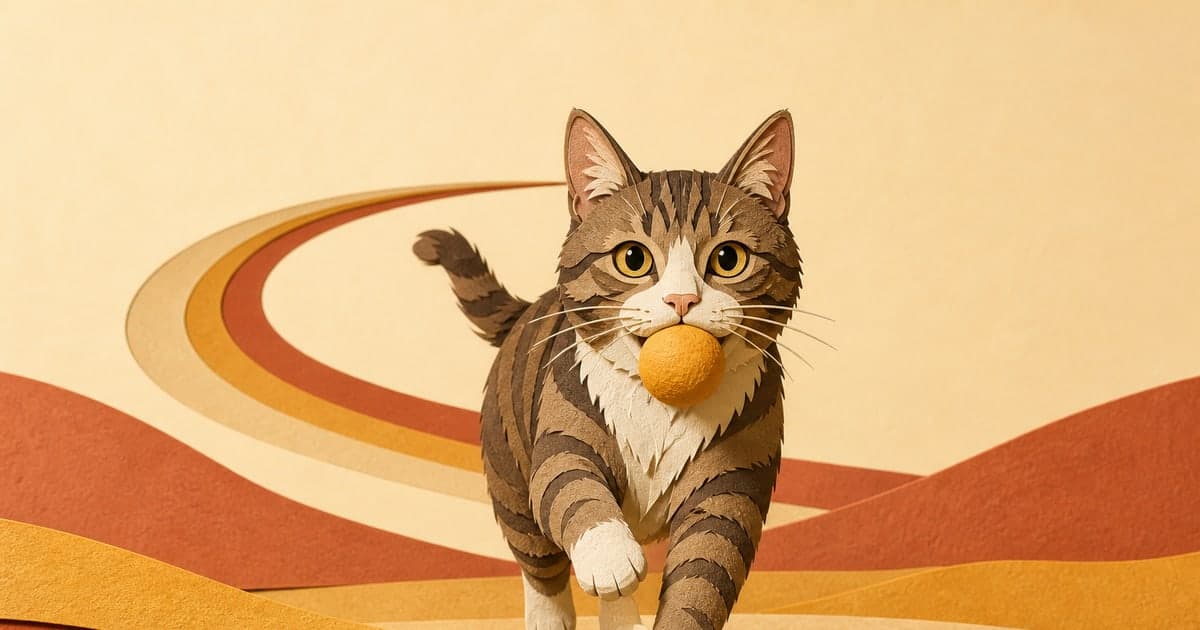
- Fetch looks like the predatory action sequence repurposed as social play.
Carrying a thrown toy back to you is supposed to be a dog thing. Some cats do it. What is going on?
A survey of 924 owners and 1,154 cats
Forman and colleagues (2023) collected reports on 1,154 fetching cats from 924 owners. The headline number: 94.4% of owners said they had not taught it. Fetch is not a product of training; cats start it themselves.
Onset was most often before one year, then between one and seven. And crucially, cats initiated and terminated bouts more often than owners did. The cat is not being dragged into a game — it is designing the exchange.
Roughly four in ten cats fetch something
Delgado and colleagues (2024) analyzed survey data from 8,224 cat owners and found fetching behavior reported in 40.9% of cats. It is not a rare quirk. Reporting rates ran higher in breeds of East Asian origin — Siamese, Burmese, Tonkinese — but mixed-breed cats show it widely.
Such breed patterns likely reflect differences in activity level and engagement with people. No fetch gene has been identified.
The hunting sequence becomes a game
Feline hunting runs as a sequence: wait, stalk, pounce, capture, carry. Carrying prey to a safe place occurs in wild cats too. Fetch reads as that carrying stage with a human location built in as the "safe place."
A fetching cat is therefore combining a predatory program with learned interaction. That is genuinely complex behavior, but it does not map onto a single-dimensional index like IQ (can feline intelligence be measured as IQ?).
How to keep the game going
First, always throw it back when the cat brings it. A run of unanswered attempts extinguishes the behavior. Second, stop when the cat stops; forcing the game turns play itself into an unpleasant context.
Third, use the object the cat chose. Crumpled paper, hair ties, and bottle caps are common picks — avoid only what could be swallowed. Fourth, complete the hunting sequence: give the cat something it can actually catch rather than ending on the chase (feline play and hunting behavior).
The link to training
That fetch arises spontaneously says something about how cats learn. Cats repeat what has produced good outcomes, not what they were told to do. The training principle is the same: shape with reward, never with punishment (can cats be trained?).
The wider map of feline behavior research is in can a cat's IQ be measured?.
What human tests measure instead
Human intelligence tests measure how quickly you find the rule in a task you have never seen (fluid and crystallized intelligence) — a different target from spontaneous behavior like fetch. NekoIQ's free IQ test covers four non-verbal domains across 20 items in about 10 minutes, returning an estimated IQ and deviation score. Results are estimates for entertainment and self-understanding.
Frequently asked questions
- Does fetching mean my cat is smart?
It is not direct evidence of higher intelligence. It is the predatory action sequence combined with human interaction, and over 94% of cases arose without training.
- Which cats fetch?
It usually begins before one year of age and is reported more often in breeds such as Siamese, though mixed-breed cats fetch too. Breed does not determine it.
- Can I teach my cat to fetch?
Responding matters more than teaching. Cats led both the start and the end of bouts in the survey, so matching their timing keeps the game alive.
Share this article
Measure your IQ for free
20 questions in about 10 minutes give you your estimated IQ, deviation score, and national ranking.
Take the IQ test →Related articles
Editorial note & disclaimer
This article was written and edited by the NekoIQ Editorial Team using peer-reviewed research in animal cognition, behavior, and veterinary science. We distinguish the study's measured result from interpretation and report limitations such as sample size, task fit, and motivation where relevant.
The tests on this site provide estimates for entertainment and self-understanding purposes only. They are not medical or clinical assessments, nor official psychological (intelligence) tests.