Do Cats Get Lonely When Left Alone? Separation-Related Problems
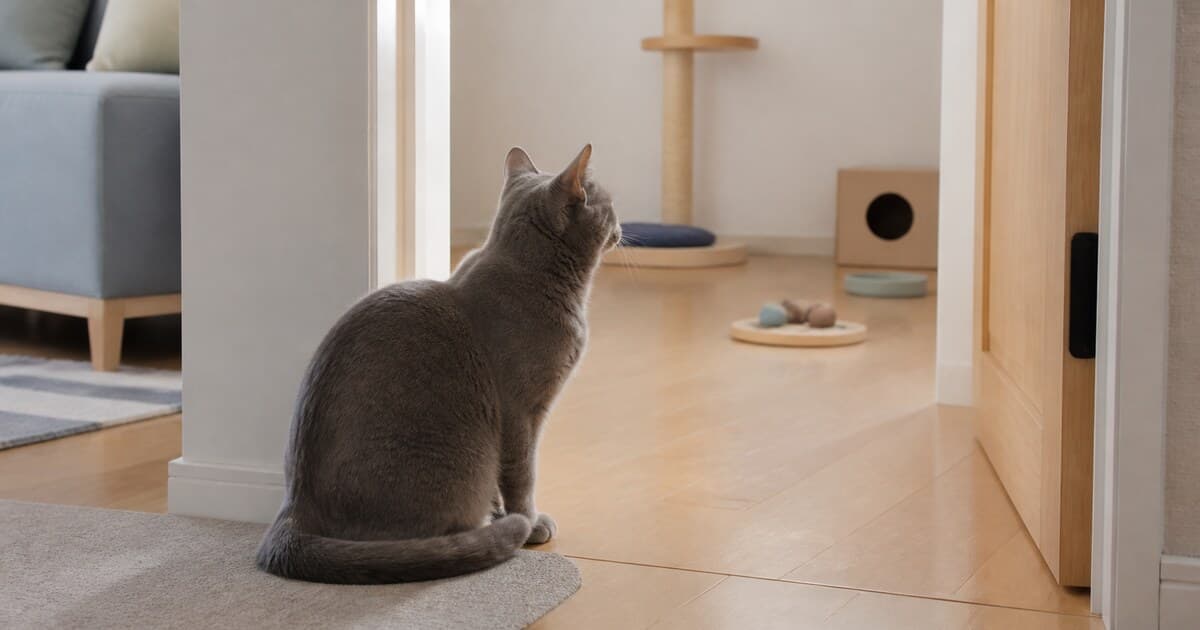
Key takeaways
- In a questionnaire study of 223 cats, 30 cats (13.45%) met at least one research criterion for separation-related problems.
- Destruction, excessive vocalization, inappropriate urination, and apathy were reported in the affected group.
- Sleeping while alone or greeting an owner warmly is not enough to identify a separation-related problem.
- House-soiling and overgrooming can also reflect disease, so veterinary assessment matters.
Cats can spend time alone, but that does not mean every cat is unaffected by an owner's absence. Research groups absence-linked behavior under the term separation-related problems.
A questionnaire study of 223 cats
de Souza Machado and colleagues (2020) interviewed 130 owners about 223 adult cats, using three criteria derived from canine research and feline case reports.
Thirty cats—13.45% of this sample—met at least one criterion. Among those 30, owners reported destruction in 66.67%, excessive vocalization in 63.33%, inappropriate urination in 60.00%, and apathy in 53.33%. These figures should not be generalized unchanged to all pet cats.
Which behaviors may be signs?
Candidates include vocalizing only during absences, destruction, elimination outside the litter box, overgrooming, pacing, or becoming unusually inactive. Extreme excitement at reunion can be considered alongside them.
The crucial question is timing: does the behavior reliably coincide with absence? If it also happens while the owner is home, litter setup, other animals, noise, and disease need consideration. Video can reveal when a behavior begins and what precedes it.
Normal time alone versus a problem
Sleeping for long periods, approaching after reunion, or vocalizing near mealtime is not by itself abnormal. Cats rest much of the day and may increase social contact when a person returns.
Eriksson and colleagues (2017) found more purring and stretching after a four-hour separation than after 30 minutes. That shows sensitivity to absence duration, not proof of separation anxiety.
Evaluation becomes important when intense behavior repeatedly occurs during absence and impairs the cat or household. Vocalizing, appetite loss, or house-soiling alone cannot establish a diagnosis.
Improving the home-alone environment
Keep departures and reunions low-key and make meals, play, and lights-out as predictable as practical. Offer window views, high places, and multiple hiding areas rather than concentrating resources in one spot.
A portion of food can go into an easy, safe puzzle feeder. If the task is too hard it will be abandoned; see research on puzzle feeders.
Practice brief absences and extend them only while the cat remains comfortable. Do not punish anxiety-linked behavior, because punishment adds uncertainty.
Sudden elimination changes, appetite loss, vomiting, and overgrooming can have medical causes. A veterinarian should rule those out and refer to behavior care if needed.
Separation responses are not intelligence
Reactions to absence combine attachment, experience, environment, and health. Vocal cats are not necessarily smarter, and calm cats have not forgotten their owners. See feline attachment research and the feline IQ guide.
NekoIQ's free IQ test estimates human attention and reasoning in 20 questions and about 10 minutes. It does not diagnose a cat's anxiety; results are estimates for self-understanding.
Frequently asked questions
- Can cats have separation anxiety?
Cats can show behavior associated with an owner's absence. Researchers often use the cautious term separation-related problems rather than applying the canine diagnosis unchanged.
- What are possible signs?
Excessive vocalizing, destruction, house-soiling, overgrooming, restlessness, or apathy during absences are candidates, after medical and environmental causes are considered.
- How can I prepare a cat for time alone?
Keep departures calm and routines steady, and provide hiding places, high perches, and safe food puzzles. Persistent signs require veterinary advice.
Share this article
Measure your IQ for free
20 questions in about 10 minutes give you your estimated IQ, deviation score, and national ranking.
Take the IQ test →Related articles
Editorial note & disclaimer
This article was written and edited by the NekoIQ Editorial Team using peer-reviewed research in animal cognition, behavior, and veterinary science. We distinguish the study's measured result from interpretation and report limitations such as sample size, task fit, and motivation where relevant.
The tests on this site provide estimates for entertainment and self-understanding purposes only. They are not medical or clinical assessments, nor official psychological (intelligence) tests.