Why Do Cats Love Boxes? They Sit in Illusory Squares Too
Key takeaways
- Cats sat in a taped square and in an outline-free illusory square at nearly equal rates.
- The result suggests cats perceive subjective contours much as humans do.
- Boxes appeal for warmth and security, not vision alone.
- Giving shelter cats a hiding box lowered stress measures in a separate study.
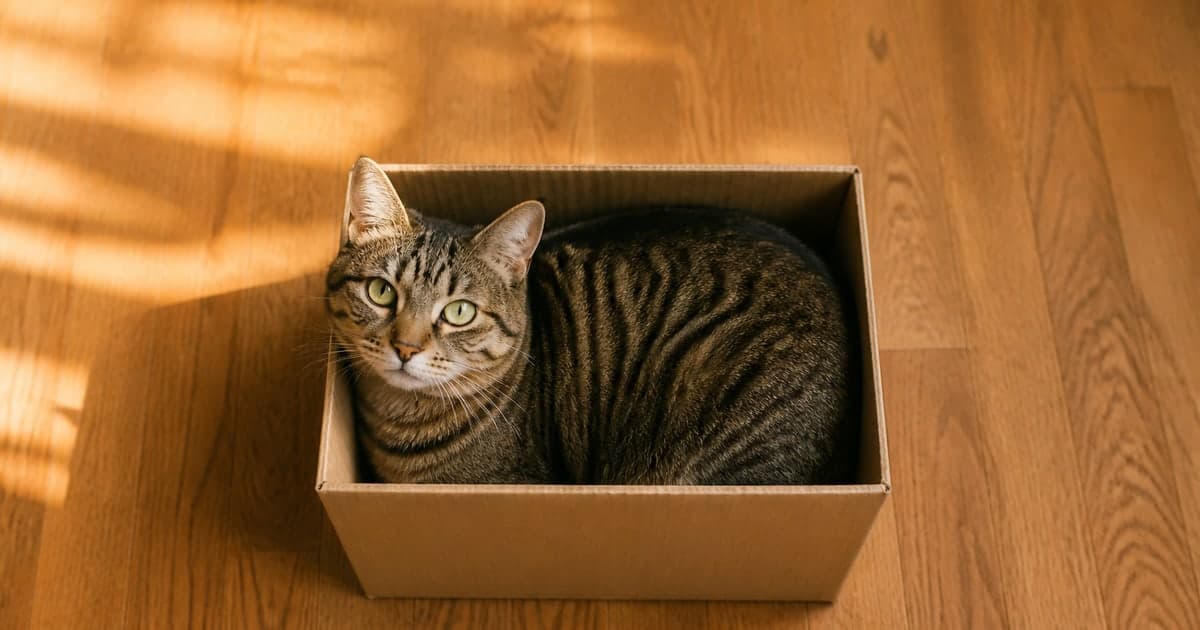
Cats get into boxes. They get into taped outlines on the floor too. So what happens with a square that has no lines at all — one that is only seen?
Putting a Kanizsa square on the floor
Smith and colleagues (2021) tested this with citizen science. Owners followed a protocol at home, laying out three figures: a real square made of tape, a Kanizsa figure of four notched circles arranged so a square appears, and a control with the same circles rotated so no square emerges.
Five hundred cats were enrolled; 30 completed the full protocol. Among the nine cats that chose consistently, the tally was eight selections of the real square, seven of the Kanizsa square, and one of the control. Cats sat in the square that was never drawn about as often as in the real one.
Subjective contours
A Kanizsa figure works because the brain completes a contour from the arrangement of notched circles. The human visual system builds continuous shapes out of interrupted information. If the same completion happens in cats, an illusory square should function as an enclosure — and that matches the result.
Contour completion has been reported in dogs as well. It plausibly helped predators treat a partly hidden prey animal as a single object. Feline visual traits are also covered in the structure of the cat brain.
Watch the sample size
The finding is striking, but the numbers are 30 completions and nine consistent choosers. The authors themselves call for replication and additional controls. Declaring from a headline that "cats see illusions" gets ahead of the evidence.
Citizen science avoids the stress of bringing cats into a lab. In exchange, protocols are harder to standardize and dropout is high — a constraint that runs through feline research.
Vision is not the only reason
Boxes are not only about illusions. A cat's comfortable temperature range sits above ours, and an enclosed space conserves body heat. A spot that limits sightlines is also a safe waiting place for an animal that is both predator and prey.
Vinke and colleagues (2014) gave hiding boxes to newly arrived shelter cats and found lower stress measures in the box group. The benefit is largest right after the environment changes.
What to do at home
First, place several open-topped boxes at different heights; cats like to survey from above. Second, never block escape routes — a hiding place without an exit is not reassuring.
Third, add boxes precisely when things change: visitors, renovations, a move. Stress also degrades performance on cognitive tasks (stress and cognition in cats). The wider map of feline behavior research is in can a cat's IQ be measured?.
Human illusions and IQ
In humans too, perceiving subjective contours is a basic property of the visual system. Figural IQ items build on that perception to measure rule discovery (Raven's Progressive Matrices). NekoIQ's free IQ test measures pattern discovery across 20 items in about 10 minutes. Results are estimates, not a clinical assessment.
Frequently asked questions
- Why do cats want to get into boxes?
An enclosed space hides them and holds warmth. Experiments show cats will also sit in an illusory square with no real outline, so the visual sense of enclosure matters on its own.
- What does sitting in an illusory square mean?
Cats sat about as often on a Kanizsa figure — four notched circles that read as a square — as on a real taped square. They were responding to a contour that was never drawn.
- Should I give my cat a box?
Yes. In a shelter study, cats given a hiding box showed lower stress measures, and the effect is largest right after the environment changes.
Share this article
Measure your IQ for free
20 questions in about 10 minutes give you your estimated IQ, deviation score, and national ranking.
Take the IQ test →Related articles
Editorial note & disclaimer
This article was written and edited by the NekoIQ Editorial Team using peer-reviewed research in animal cognition, behavior, and veterinary science. We distinguish the study's measured result from interpretation and report limitations such as sample size, task fit, and motivation where relevant.
The tests on this site provide estimates for entertainment and self-understanding purposes only. They are not medical or clinical assessments, nor official psychological (intelligence) tests.