Does Play Make Cats Smarter? Research on Feline Play and Hunting
Key takeaways
- Social play in kittens rises from about four weeks and peaks around nine to fourteen weeks.
- Object play increases as social play declines, in a rough handover.
- Evidence that play functions as hunting practice remains limited.
- Play persists into adulthood and is used as an indicator of environmental quality.
Watching a cat chase a wand toy, most people conclude it is practicing to hunt. How far does that explanation hold?
Play develops in two stages
Delgado and Hecht (2019) review the research on feline play. Kitten play divides broadly into two kinds: social play, wrestling with littermates, and object play, batting and chasing things.
Social play appears around four weeks and peaks around nine to fourteen weeks. It then declines while object play rises in its place — a handover that coincides with weaning and the shift to feeding independently.
The weakness in the "hunting practice" account
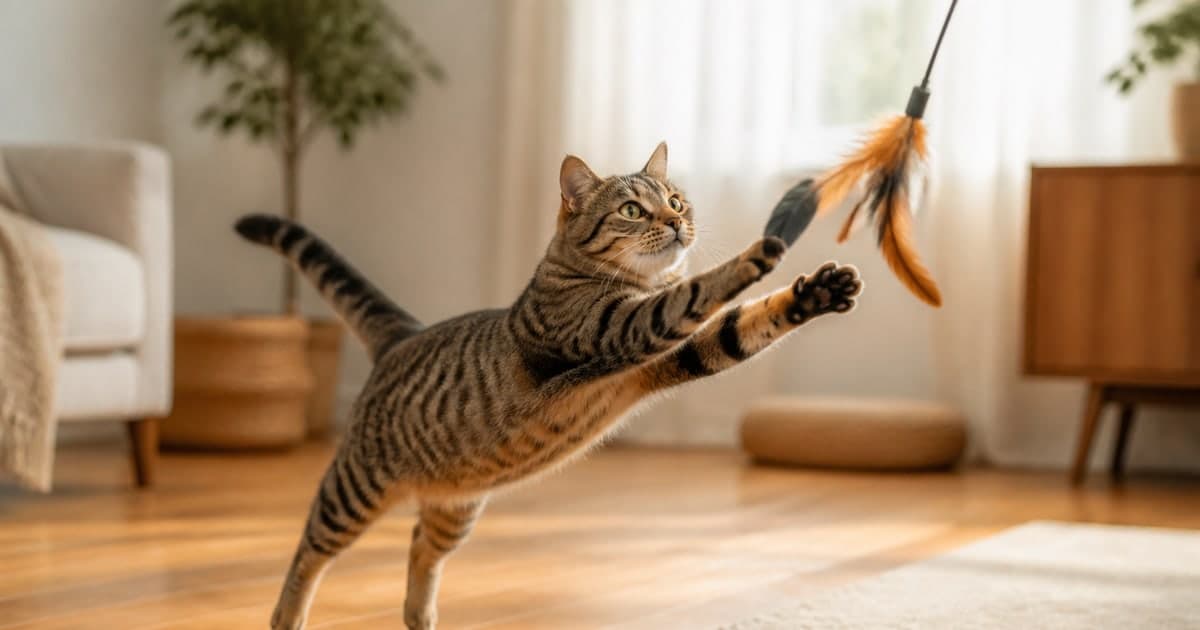
Play movements resemble hunting closely: waiting, stalking, pouncing, pinning with the forepaws. What the review points out is that almost no empirical data ties the amount of play to later hunting success.
The stronger reading is that play serves several functions at once — motor development, neural maturation, social skill acquisition. Not reducing it to a single purpose fits the observations better.
Play and cognition
There is no evidence that play directly raises anything like an IQ score. But across species, animals in play-deprived environments perform worse on cognitive tasks, because impoverished surroundings remove the opportunities for learning themselves.
In cats, the effects of turning feeding into a task have been examined (do puzzle feeders work for cats?). Arrangements that put a step between the cat and its food satisfy play and feeding at once.
Designing play: complete the sequence
First, run the hunting sequence to its end. Do not stop at the chase; give the cat something it can catch. Play that never resolves in a capture leaves frustration behind.
Second, make the movement prey-like. Rather than waving the toy in front of the cat's face, move it away and into cover. Third, keep sessions short. Feline hunting is repeated bursts of concentration, not sustained exercise.
Fourth, serve food after play. Following the natural chain — hunt, catch, eat, groom, sleep — helps settle the daily rhythm.
Reading a cat that will not play
Reduced play signals pain and illness as well as boredom. Arthritis is common in older cats and discourages play involving jumps. A sudden change warrants a veterinary visit (aging and cognition in cats).
The invitation may also be wrong for this cat. Response varies enormously with the object, the speed of movement, and the time of day. Finding the conditions a cat responds to is itself the work of getting to know it. The wider map of feline behavior research is in can a cat's IQ be measured?.
Play and cognition in humans
In humans too, play and learning are inseparable. Claims that play directly raises IQ still need caution, and brain-training research turns on the distinction between near and far transfer (can IQ be raised?). NekoIQ's free IQ test covers four non-verbal domains across 20 items in about 10 minutes, returning an estimated IQ and percentile. Results are estimates for self-understanding.
Frequently asked questions
- Is a cat's play hunting practice?
It is often described that way, but the evidence is limited. No clear relationship has been shown between how much a kitten plays and how well it later hunts.
- How much should an adult cat play?
Split it up. Several five- to ten-minute sessions a day, each completing the hunting sequence, sustain attention better than one long session.
- Should I worry if my cat stops playing?
A sudden change is worth a vet visit. Pain, illness, and severe stress all reduce play; a gradual decline with age is normal.
Share this article
Measure your IQ for free
20 questions in about 10 minutes give you your estimated IQ, deviation score, and national ranking.
Take the IQ test →Related articles
Editorial note & disclaimer
This article was written and edited by the NekoIQ Editorial Team using peer-reviewed research in animal cognition, behavior, and veterinary science. We distinguish the study's measured result from interpretation and report limitations such as sample size, task fit, and motivation where relevant.
The tests on this site provide estimates for entertainment and self-understanding purposes only. They are not medical or clinical assessments, nor official psychological (intelligence) tests.