Do Cats Dream? Research on REM Sleep and Sleep Deprivation
Key takeaways
- Cats have wakefulness, non-REM sleep, and REM sleep, distinguishable through brain waves and muscle activity.
- After eight adult cats were kept awake for 14 hours, non-REM and REM sleep and slow-wave activity increased.
- REM sleep does not reveal what a cat dreams about or whether it experiences dreams consciously.
- Sleep varies widely; abrupt changes or difficulty waking deserve attention as possible health changes.
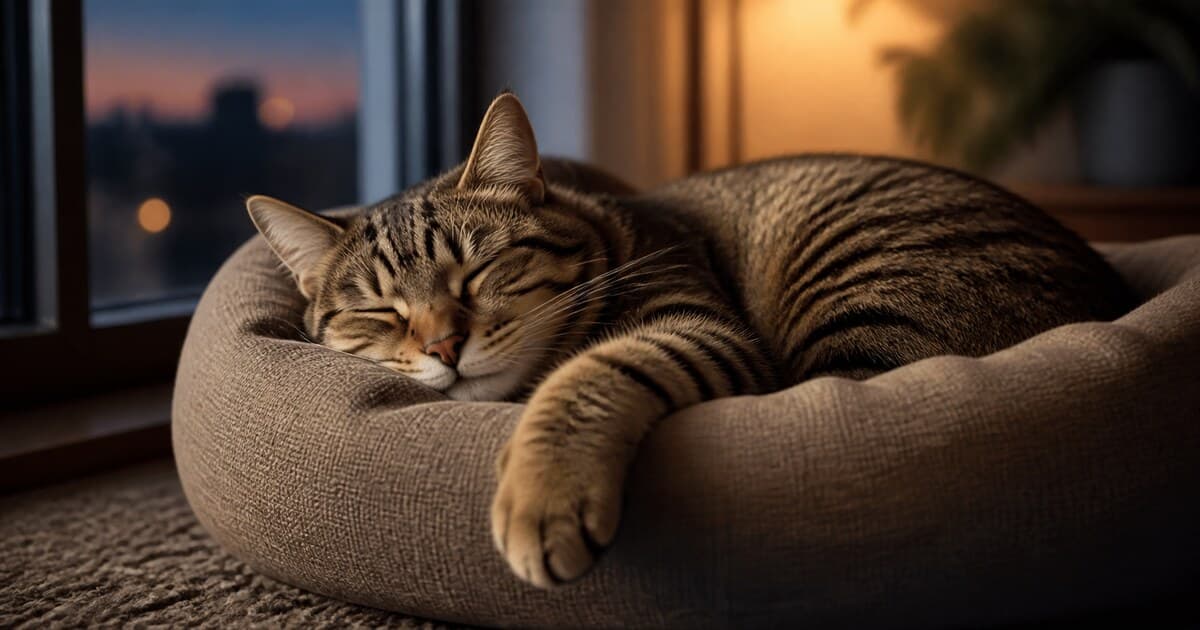
When a sleeping cat's whiskers move and its paws twitch as if running, a hunt in a dream is tempting to imagine. Sleep stages can be measured; dream content is a separate question.
Cats have REM and non-REM sleep
Brain waves, eye movements, and muscle tone distinguish feline wakefulness, non-REM sleep, and REM sleep. REM features eye movement and reduced muscle tone; non-REM contains more slow-wave brain activity.
Tobler and Scherschlicht (1990)90086-T) recorded brain activity and movement from eight adult cats for almost a day. After play kept them awake for 14 hours, non-REM and REM sleep rose modestly, while non-REM slow-wave activity first increased and then declined.
That pattern shows sleep homeostasis: the feline brain responds physiologically to lost sleep rather than sleeping only from boredom.
Does REM sleep prove dreaming?
Humans report dreams often when awakened from REM sleep, so the association is strong. Cats cannot give a verbal report after waking; the presence of REM does not directly prove dream content or conscious awareness.
Paw, ear, and whisker movement is equally ambiguous. It may reflect muscle activity, outside stimulation, or a transition between sleep stages—not a specific dream about prey.
How sleep loss appears in the feline brain
Greater slow-wave activity after deprivation indicates that sleep depth adjusted to prior wakefulness, a basic regulatory pattern also seen in humans and other mammals.
The study involved only eight cats in a controlled setting. It did not directly test household sleep duration, age differences, memory, or problem-solving after sleep loss.
Do not intentionally interrupt sleep to test intelligence. Cats need resting places they can choose, leave, and use without disturbance.
Is a cat that sleeps a lot abnormal?
Cats take many short rests and alternate deep sleep with lighter states that preserve awareness. Age, activity, temperature, other animals, and indoor-outdoor access all change total time, so one fixed number is not diagnostic.
Watch for change from that cat's baseline: staying in bed, difficulty waking, less play, poor appetite, or pain together justify a health check. See aging and cognition in cats.
Night vocalization or an apparent day-night reversal may also involve pain, sensory decline, or cognitive change rather than sleep habits alone. Consult a veterinarian.
Do not confuse sleep with intelligence
Adequate sleep supports normal brain function, but no evidence shows that cats with more sleep or REM have higher IQ. Sleep stages and cognitive tasks require separate measurement.
See the feline brain and cortical neurons and the feline IQ guide for the broader evidence.
NekoIQ's free IQ test estimates human reasoning in 20 questions and about 10 minutes. It does not diagnose sleep or health; use the result as an estimate.
Frequently asked questions
- Do cats dream?
REM sleep is established in cats, but cats cannot report their experience, so the content and awareness of dreams cannot be confirmed scientifically.
- Do twitching paws mean a cat is dreaming?
Movement can occur with muscle activity or transitions between sleep stages. It cannot identify a dream's content.
- What if my cat suddenly sleeps much more?
Age and temperature affect rest, but an abrupt change with poor appetite, pain, or reduced responsiveness should be discussed with a veterinarian.
Share this article
Measure your IQ for free
20 questions in about 10 minutes give you your estimated IQ, deviation score, and national ranking.
Take the IQ test →Related articles
Editorial note & disclaimer
This article was written and edited by the NekoIQ Editorial Team using peer-reviewed research in animal cognition, behavior, and veterinary science. We distinguish the study's measured result from interpretation and report limitations such as sample size, task fit, and motivation where relevant.
The tests on this site provide estimates for entertainment and self-understanding purposes only. They are not medical or clinical assessments, nor official psychological (intelligence) tests.