Are Cats Left- or Right-Pawed? Paw Preference and Brain Lateralization
Key takeaways
- Cats show individually consistent front-paw preferences in experimental tasks.
- Females significantly prefer the right paw and males the left.
- At 12 weeks and 6 months most cats are ambilateral; a lateral bias becomes evident at one year.
- The bias is thought to reflect lateralization—the division of labor between brain hemispheres.
When your cat reaches for a treat, does it always lead with the same paw? The feline equivalent of handedness turns out to be real.
Bias appears as the task gets harder
Wells and Millsopp (2009) examined how pet cats used their front paws across tasks of differing difficulty, and reported that the expression of left-right bias varied with what the task demanded.
Simple reaching tends to be ambilateral; the harder, more manipulative the task, the more consistent the bias. Humans work the same way—handedness shows up far more clearly in precise operations than in casual movements.
Females right, males left
Wells and Millsopp (2012) tracked how paw preference develops, testing 12 cats at 12 weeks, 6 months, and one year on a food-retrieval challenge.
Lateralized behavior was strongly sex related. Females showed a greater preference for the right paw, while males were significantly more inclined to use the left. This sex difference has been reported repeatedly and is discussed in relation to the effects of sex hormones on brain development.
The bias settles at one year
The same study also mapped the developmental order. At 12 weeks and 6 months, cats were significantly more likely to be ambilateral than paw-preferent, while at one year they were more likely to show a lateral bias. Preferences at 6 months and at one year were positively correlated, so early tendencies persist.
A cat's 'handedness,' then, is not fixed from birth; it settles gradually through development.
What the bias means
Paw preference is regarded as an external indicator that the two brain hemispheres take on different roles—lateralization. It has been found in many vertebrates and is not unique to cats.
Note that paw preference does not indicate cognitive ability. In humans, no systematic intelligence difference between right- and left-handers has been established. Feline brain structure is covered in what is a cat's brain like?.
How to check at home
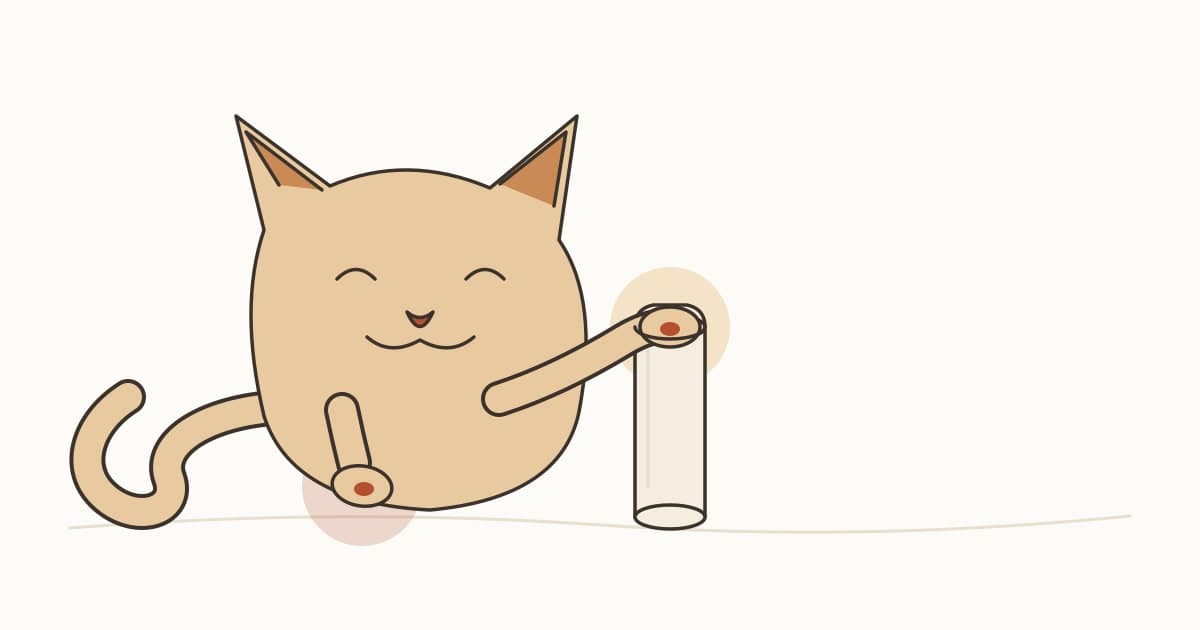
Put a treat at the bottom of a narrow tube—an empty toilet-paper roll works—and record which paw your cat uses to fish it out. Three points matter. First, make the task hard enough that the cat must insert a paw; easy tasks produce no bias. Second, place the tube directly in front of the cat so body orientation does not create a bias. Third, record at least about 50 trials spread across separate days.
One or two observations cannot be told apart from chance. Seeing a statistical bias takes repetition (five feline intelligence tests to try at home).
Lateralization and cognition in humans
In humans, lateralization is studied as the division of labor for language and spatial processing (types of cognitive ability). The free NekoIQ IQ test presents non-verbal items on rotation and rule discovery across 20 questions in about 10 minutes. Results are estimates for self-understanding and are not a substitute for an official intelligence test.
Frequently asked questions
- Do cats have a dominant paw?
Yes. On tasks such as retrieving food from a container, individual cats show consistent preferences, with females tending toward the right paw and males toward the left.
- When does a cat's paw preference form?
At 12 weeks and 6 months, most cats use either paw. A clear left-right bias becomes significantly more common at one year of age.
- Does paw preference indicate intelligence?
No. Paw preference is an indicator of brain lateralization, not of cognitive ability.
Share this article
Measure your IQ for free
20 questions in about 10 minutes give you your estimated IQ, deviation score, and national ranking.
Take the IQ test →Related articles
Editorial note & disclaimer
This article was written and edited by the NekoIQ Editorial Team using peer-reviewed research in animal cognition, behavior, and veterinary science. We distinguish the study's measured result from interpretation and report limitations such as sample size, task fit, and motivation where relevant.
The tests on this site provide estimates for entertainment and self-understanding purposes only. They are not medical or clinical assessments, nor official psychological (intelligence) tests.