Do Cats Get Dementia? Cognitive Change With Age
/
Key takeaways
- About 28% of cats aged 11 to 14 are reported to show at least one geriatric-onset behavioral problem.
- For cats aged 15 and over, that figure rises above 50%.
- Typical signs are night-time vocalizing, disorientation, litter-box accidents, and changed responses to people.
- The same signs occur with hyperthyroidism, hypertension, and pain, so veterinary differential diagnosis comes first.
An older cat yowls loudly at night, stands motionless in a corner, or stops using a familiar litter box. These changes are easily dismissed as old age, but they are a studied area of cognitive decline.
Cognitive dysfunction in older cats
Gunn-Moore and colleagues (2007) reviewed cognitive dysfunction and the neurobiology of aging in cats. The review cites reports that about 28% of cats aged 11 to 14 show at least one geriatric-onset behavioral problem, rising to over 50% among cats aged 15 and older.
Neuropathologically, older cats' brains show amyloid-beta accumulation and neuronal changes, overlapping in part with age-related changes in humans. More recent findings are summarized in the review by Sordo and colleagues (2021).
Four signs that are easy to notice
- Night-time vocalizing: loud, sustained calling after dark, with reduced response when called.
- Disorientation: staring into corners, getting stuck behind furniture, losing track of exits.
- Disrupted rhythm: day and night reversing, sleep breaking into fragments.
- Changed relationships: extreme clinginess, or avoidance of contact with people and other cats.
These surface as changes in short-term memory and spatial tracking. How feline memory and spatial cognition have been studied is covered in how good a cat's memory is.
Rule out medical causes first
An important caveat: none of these signs is specific to cognitive dysfunction. Hyperthyroidism, hypertension, chronic kidney disease, arthritic pain, and declining vision or hearing produce the same behaviors — and many of them are treatable.
So examination comes before any conclusion about dementia. Recording when the changes began and how often they occur gives your veterinarian useful material for the differential.
Adjustments that help at home
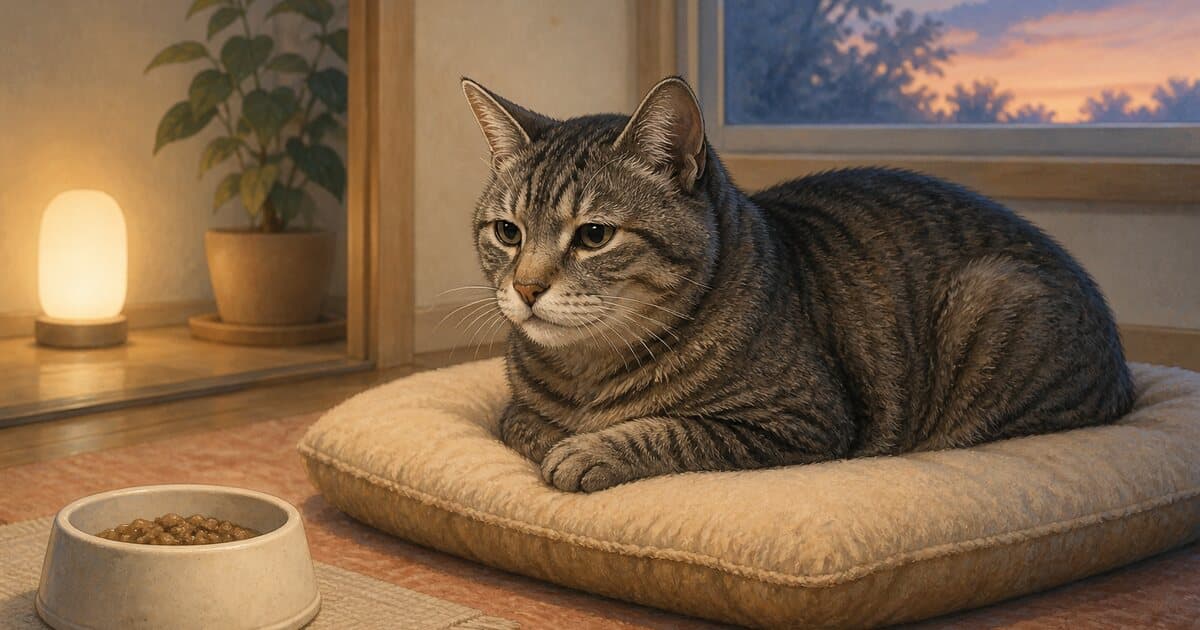
Alongside veterinary care, environmental changes help: add litter boxes to shorten the distance, switch to low-sided boxes, place steps at height changes, add a night light, and keep meals and bedtime on a fixed schedule. Avoid rearranging furniture, which adds confusion.
Moderate mental stimulation is also recommended, starting at a low difficulty for an older cat (see do puzzle feeders work for cats).
Human cognition changes with age too
In humans, fluid intelligence declines gradually with age while crystallized abilities such as vocabulary and knowledge hold up for much longer (see fluid versus crystallized intelligence and how IQ changes with age). Cognitive change is never uniform.
The full picture of feline cognition research is organized by topic in can a cat's IQ be measured?. Research aligning feline and human brain aging, and linking inflammation and body condition to cognitive change, is covered in Do cat brains age like ours?.
To check your own current tendencies, the free NekoIQ IQ test covers four domains in 20 questions and about 10 minutes. Results are estimates for self-understanding, not a medical or diagnostic assessment nor a substitute for an official intelligence test. For your cat's health, always consult a veterinarian.
Frequently asked questions
- Do cats develop dementia?
A condition known as cognitive dysfunction syndrome is reported in cats, with night-time vocalizing, disorientation, and disrupted daily rhythms appearing in older animals.
- At what age should I start watching for it?
About 28% of cats aged 11 to 14 and more than 50% of cats aged 15 and over are reported to show at least one geriatric-onset behavioral problem, so around age 11 is a reasonable point to start paying attention.
- Is night-time yowling a sign of dementia?
It can be, but hyperthyroidism, hypertension, joint pain, and failing eyesight also cause it. Have a veterinarian rule those out rather than deciding on your own.
Share this article
Measure your IQ for free
20 questions in about 10 minutes give you your estimated IQ, deviation score, and national ranking.
Take the IQ test →Related articles
Editorial note & disclaimer
This article was written and edited by the NekoIQ Editorial Team using peer-reviewed research in animal cognition, behavior, and veterinary science. We distinguish the study's measured result from interpretation and report limitations such as sample size, task fit, and motivation where relevant.
The tests on this site provide estimates for entertainment and self-understanding purposes only. They are not medical or clinical assessments, nor official psychological (intelligence) tests.