How Big Is a Cat's Brain? Neurons, Size, and Intelligence
/
Key takeaways
- A cat's cerebral cortex is estimated to hold about 250 million neurons; a dog's, about 530 million.
- Brain size and neuron count are not proportional: a brown bear's cortex is ten times a cat's yet holds a similar number of neurons.
- The human cerebral cortex is estimated at about 16 billion neurons — orders of magnitude more.
- Neuron count indicates available processing resources; it does not convert into an intelligence score.
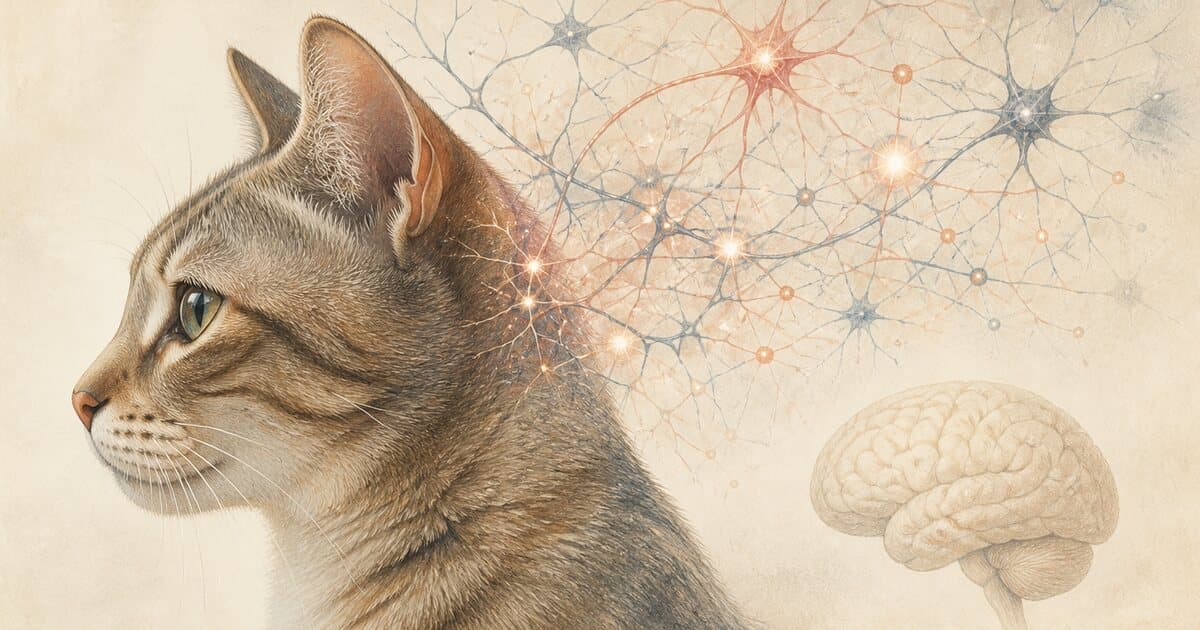
Brain size looks like an intuitive index of intelligence. The more research accumulates, the less that intuition holds. A cat's brain is a good place to see why.
About 250 million cortical neurons
Jardim-Messeder and colleagues (2017) estimated cortical neuron counts across several carnivoran species, reporting about 250 million for cats and about 530 million for dogs. For comparison, the human cerebral cortex is estimated at about 16 billion — two orders of magnitude higher.
Neuron count is one indicator of the processing resources available. It is not, however, a simple ladder where more means smarter, as another result from the same study makes clear.
Brain size does not guarantee neuron count
The same work found that a brown bear's cerebral cortex, roughly ten times the size of a cat's, holds a comparable number of neurons. A large brain does not necessarily pack in proportionally more cells.
The finding is explained as a trade-off: heavier species pay more to maintain a brain, and resources go toward supporting a large body rather than raising neuron density. That is why ranking species by absolute brain size carries little meaning.
A cat's brain is optimized for a cat's life
In the feline brain, regions serving smell, hearing, and the motor control and balance that hunting demands occupy important positions. Vision in low light, accuracy in localizing sounds, and postural control mid-leap all far exceed human capability.
The human brain, by contrast, devotes enormous resources to language and long-range planning. The question is not which is superior but what each is optimized for. Research on feline spatial ability is collected in can feline intelligence be measured as IQ.
Even in humans, brain size correlates weakly with IQ
Studies in humans find a real but weak correlation between brain volume and test scores, with almost no power to predict an individual's ability. Individual differences in intelligence are thought to depend more on the efficiency and connectivity of neural circuits than on size (see IQ and genetics and what the g factor is).
Judging intelligence from brain specifications therefore has limits both across species and within one. The cross-species discussion continues in which is smarter, cats or dogs.
The full picture of feline cognition research is organized by topic in can a cat's IQ be measured?.
What can be measured is the human side
Measuring actual task performance beats inferring cognition from anatomy. The free NekoIQ IQ test scores four domains — spatial reasoning, pattern recognition, logical inference, and classification — with item response theory (IRT) in 20 questions and about 10 minutes, producing an estimated IQ, deviation score, and national ranking. Results are estimates for self-understanding and are not a substitute for an official intelligence test.
Frequently asked questions
- How many neurons does a cat's brain have?
About 250 million in the cerebral cortex. Using the same method, dogs are estimated at about 530 million and humans at about 16 billion.
- Does a bigger brain mean more intelligence?
Not necessarily. A brown bear's cortex is roughly ten times the size of a cat's yet is estimated to hold a similar number of neurons.
- Is a cat's brain similar to a human's?
The basic structures are shared, but scale and regional proportions differ. Cats devote relatively more capacity to smell, hearing, and motor control than humans do.
Share this article
Measure your IQ for free
20 questions in about 10 minutes give you your estimated IQ, deviation score, and national ranking.
Take the IQ test →Related articles
Editorial note & disclaimer
This article was written and edited by the NekoIQ Editorial Team using peer-reviewed research in animal cognition, behavior, and veterinary science. We distinguish the study's measured result from interpretation and report limitations such as sample size, task fit, and motivation where relevant.
The tests on this site provide estimates for entertainment and self-understanding purposes only. They are not medical or clinical assessments, nor official psychological (intelligence) tests.