Can Cats Count? What Quantity-Discrimination Experiments Show
/
Key takeaways
- Even untrained cats tend to choose the larger amount when the difference in food quantity is large.
- The preference became significant when the ratio between the two amounts was below 0.5 — a difference of more than double.
- When the food was hidden from view, cats no longer chose the larger amount, suggesting they relied mainly on visual cues.
- Cats can be trained to discriminate two items from three, but that is not evidence of counting as humans do.
Serve a smaller portion and your cat seems annoyed. Living with cats produces plenty of moments that suggest they notice differences in quantity. Numerical cognition is a well-studied topic in animal research, and cats have been tested too.
Untrained cats still pick the larger amount
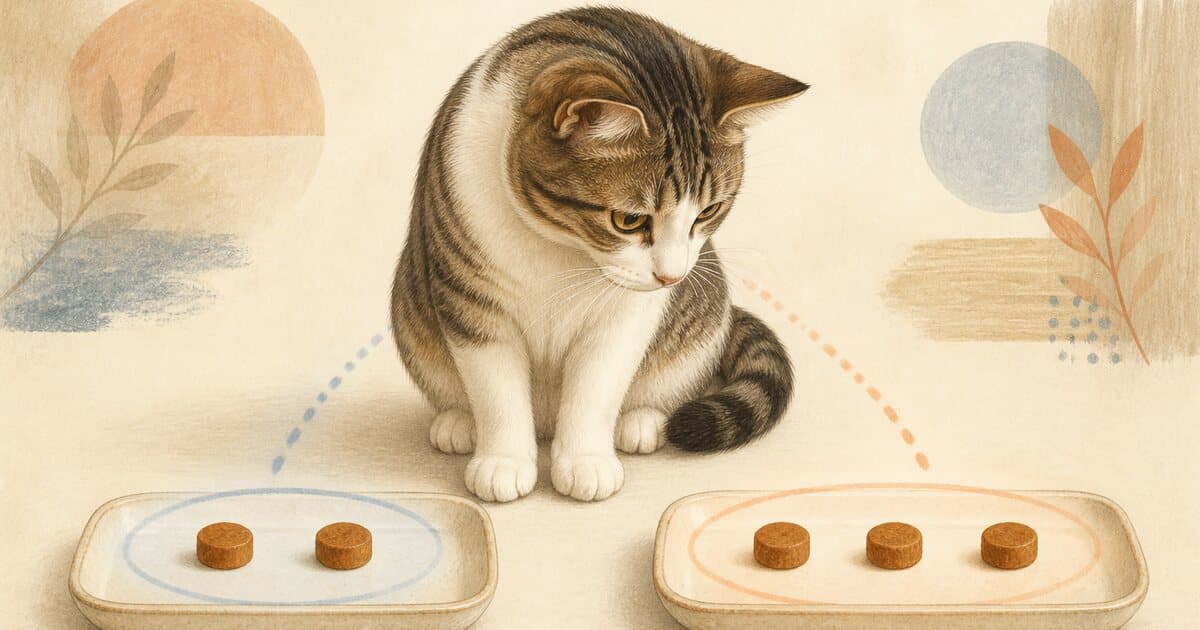
Bánszegi and colleagues (2016) offered untrained household cats two different quantities of food and recorded their choices. Overall the cats chose the larger amount, significantly so when the ratio between the two quantities was below 0.5 — that is, when one pile was more than double the other.
This dependence on ratio is shared by many animals, humans included. One item versus five is easy; eight versus nine is hard. Precision set by relative ratio rather than absolute count is known as Weber's law.
Hide the food and the ability disappears
In another experiment from the same work, the quantities were hidden from the cats' view before the choice. Under that condition, cats no longer preferred the larger amount. The researchers concluded that the cats had been comparing quantities mainly through visual cues.
In other words, cats respond to how much they can see, not necessarily to a number held in mind and compared. That distinction matters: it places feline performance at a different level from the human concept of number. For the human side, see how to solve number-sequence problems.
Training produces two-versus-three discrimination
Pisa and Agrillo (2009) trained four pet cats to discriminate two dots from three for a food reward. The cats learned to tell apart two groups of objects that differed only in number.
Trained discrimination still does not prove counting. Continuous cues such as total area or arrangement always remain a possible basis for the choice, so researchers must control conditions tightly to rule them out. That difficulty is why progress in animal number research is slow.
Numeracy is not a marker of general intelligence
Quantity discrimination is not a universal index of intelligence. Fish and birds show it too. It most likely evolved independently many times because quickly estimating the size of a food source or a group carried survival value.
For cats, then, the sensible reading is not 'counts, therefore smart' but 'has the estimation ability that hunting and foraging require.' For broader coverage see can feline intelligence be measured as IQ and what human age a cat's IQ corresponds to.
The full picture of feline cognition research is organized by topic in can a cat's IQ be measured?.
Human number sense can be measured
Humans also have a number sense that works without counting. Sequence and rule problems on intelligence tests draw on both that sense and logical inference (see types of cognitive ability). The free NekoIQ IQ test shows your tendencies across spatial reasoning, pattern recognition, logical inference, and classification in 20 questions and about 10 minutes. Results are estimates for self-understanding and are not a substitute for an official intelligence test.
Frequently asked questions
- Can cats count?
There is no evidence that cats count using number words as humans do. They can discriminate larger from smaller quantities, and accuracy improves as the difference grows.
- How many items can a cat distinguish?
Trained cats learned to discriminate two items from three. Without training, the preference for the larger amount became significant when the ratio was below 0.5 — more than a twofold difference.
- Will a cat notice if its portion shrinks?
Possibly, when the food is visible. In experiments where quantities were hidden, choices dropped to chance level, indicating heavy reliance on vision.
Share this article

Measure your IQ for free
20 questions in about 10 minutes give you your estimated IQ, deviation score, and national ranking.
Take the IQ test →Related articles
Editorial note & disclaimer
This article was written and edited by the NekoIQ Editorial Team using peer-reviewed research in animal cognition, behavior, and veterinary science. We distinguish the study's measured result from interpretation and report limitations such as sample size, task fit, and motivation where relevant.
The tests on this site provide estimates for entertainment and self-understanding purposes only. They are not medical or clinical assessments, nor official psychological (intelligence) tests.