What Human Age Is a Cat's IQ? Why It Cannot Be Scored
/
Key takeaways
- There is no scientifically accepted way to convert a cat's intelligence into a human IQ score or age.
- Human IQ is a relative value, standardized to a mean of 100 and a standard deviation of 15 within a human age group.
- Feline intelligence is tested one task at a time: name discrimination, tracking unseen objects, and short-term memory.
- Phrases like 'equivalent to a human toddler' are simplifying metaphors, not measurement results.
'What human age is my cat's IQ?' is a question almost everyone who lives with a cat eventually types into a search box. The short answer: there is no scientifically accepted way to convert feline intelligence into a human score or age. But that is not the end of the story — experiments have gradually revealed how much cats actually understand.
Where the 'cat equals a two-year-old' figure comes from
Pet articles often claim that a cat's intelligence matches that of a human toddler. This is an analogy drawn from situations where cats and young children look alike — searching for hidden objects, responding to names, learning simple cause and effect. It is not a number produced by administering an intelligence test to a cat.
Developmental assessments for young children assume verbal comprehension and manual manipulation. Giving the same tasks to an animal that handles objects with its forepaws and relies heavily on smell and hearing measures bodies and senses, not ability. Age equivalence is a convenient conversational shorthand, but treating it as a measurement invites misunderstanding.
Human IQ describes a position within a human group
Human IQ is not an absolute quantity of ability. It is a relative position obtained by refitting the score distribution of a human age group onto a normal distribution with a mean of 100 and a standard deviation of 15 (see what IQ means and what the average IQ is). How many people fall into each band is shown in our IQ distribution data.
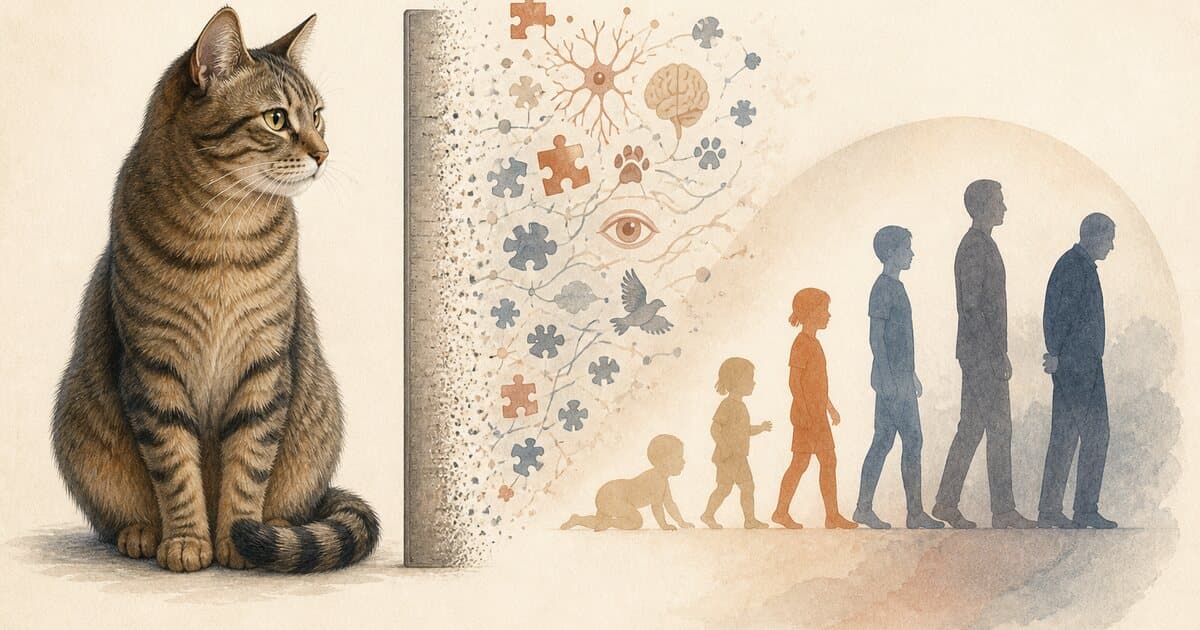
An IQ figure is therefore meaningless without its reference group. Because a cat cannot be placed in a human reference group, a feline IQ value cannot be defined in principle. That is a statement about the ruler being built for humans, not about cats falling short.
Feline intelligence is verified task by task
Animal-cognition research confirms one question at a time rather than producing a single score. For cats, results so far include the following.
- Name discrimination: Saito and colleagues (2019) found that household cats responded differently to their own names than to general nouns or other cats' names.
- Owner voice recognition: Saito and Shinozuka (2013) found that cats distinguished their owner's voice from strangers' voices, orienting with their ears and heads.
- Tracking an unseen location: Takagi and colleagues (2021) rated cats as more surprised when an owner's voice appeared to jump implausibly between locations.
- Short-term memory: in Fiset and Doré (2006), accuracy in finding a hidden object fell rapidly between 0 and 30 seconds yet stayed above chance at 60 seconds.
- Inference from sound: Takagi and colleagues (2016) found that cats looked longer at containers when the rattling sound and the contents did not match.
None of these ask what a cat scores; they ask what a cat does. We cover more in can feline intelligence be measured as IQ and how good a cat's memory is.
Comparisons with dogs do not settle a ranking either
Miklósi and colleagues (2005) compared dogs and cats on finding food from a human pointing gesture and reported no significant difference in performance. The same work noted that dogs were easier to keep engaged in testing. A cat's result may reflect weak motivation to cooperate with a laboratory task rather than a lack of ability.
Brains differ too. Jardim-Messeder and colleagues (2017) estimated about 530 million cortical neurons in dogs and about 250 million in cats. Neuron counts are not intelligence itself; see which is smarter, cats or dogs for the full comparison.
Observation beats chasing a number
If you want to understand your cat's intelligence, observing what it responds to beats hunting for a score. Ear movements when you call its name, how long it searches for a hidden toy, how closely it attends to a rattling container — the cues used in research can be watched at home (see feline intelligence tests you can try at home).
The full picture of feline cognition research is organized by topic in can a cat's IQ be measured?.
Human intelligence falls into the same trap when reduced to one total. Two people with identical overall IQs can have completely different profiles of spatial reasoning and memory (see types of cognitive ability). The free NekoIQ IQ test shows your estimated IQ and your profile across four domains in 20 questions and about 10 minutes. It does not measure your cat — it measures you, with cats for company. Results are estimates for self-understanding and are not a substitute for an official intelligence test.
Frequently asked questions
- What human age is a cat's IQ equivalent to?
There is no accepted conversion. Human IQ tests are standardized against human age groups, and cats differ too much in sensation and motivation for the same scale to apply.
- What is the average IQ of a cat?
Cats have no IQ scale at all — nothing equivalent to a mean of 100 and an SD of 15. Research evaluates cognition by whether specific tasks can be solved, not by points.
- Does feline intelligence differ by breed?
Studies report behavioral differences between breeds, but no test compares intelligence itself across breeds. Our article on the smartest cat breeds covers this in detail.
Share this article

Measure your IQ for free
20 questions in about 10 minutes give you your estimated IQ, deviation score, and national ranking.
Take the IQ test →Related articles
Editorial note & disclaimer
This article was written and edited by the NekoIQ Editorial Team using peer-reviewed research in animal cognition, behavior, and veterinary science. We distinguish the study's measured result from interpretation and report limitations such as sample size, task fit, and motivation where relevant.
The tests on this site provide estimates for entertainment and self-understanding purposes only. They are not medical or clinical assessments, nor official psychological (intelligence) tests.