Do Cats Recognize Themselves in a Mirror? Where the Research Stands
/
Key takeaways
- No peer-reviewed study reports that cats pass the mirror mark test.
- The mark test was established with chimpanzees in 1970 and depends heavily on vision.
- An olfactory self-recognition test with dogs found they attended longer to their own modified odor.
- Failing the test is not proof that a sense of self is absent; the task may simply not fit the species' senses.
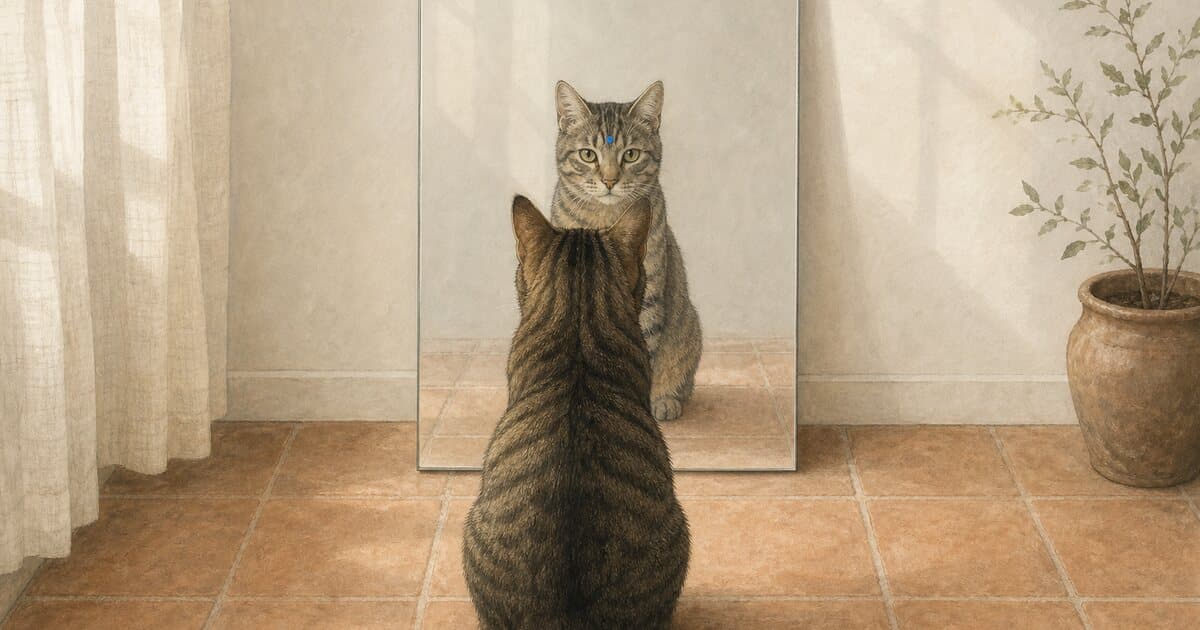
Some cats puff up in front of a mirror, some go looking behind it, and some ignore it entirely. Reactions vary widely, which is why the topic fascinates owners. In research, it connects to a much larger question about self-awareness.
How the mirror mark test works
Gallup (1970) gave chimpanzees prolonged exposure to mirrors, then marked them with dye, while anesthetized, in a spot they could not see directly. On waking, the chimpanzees looked in the mirror and touched the mark on their own bodies. This was interpreted as evidence of recognizing the reflection as the self, and the procedure became the standard.
Species reported to pass are few: great apes, some dolphins, elephants, and magpies among them. There is no peer-reviewed report of a cat passing.
What cats typically do with mirrors
Most cats meeting a mirror for the first time behave as if a strange cat were present — arching the back, checking behind the glass. After a while the reaction fades and the mirror is generally ignored.
That habituation cannot be read as understanding. Even when the reflection tracks its movements perfectly, a cat may simply learn that this object carries no smell and no sound, and file it away as unimportant.
A visual test may not suit a cat
The mark test leans heavily on vision. For cats, though, the most important information for identifying individuals is olfactory and auditory. Cats do discriminate their owner's voice (Saito and Shinozuka, 2013) and their own names from other words (Saito and colleagues, 2019). Failure on a visual task may reflect a mismatch of senses.
That concern motivated an olfactory version for dogs. Horowitz (2017) reported that dogs spent longer investigating their own odor when it had been altered with an added scent than when it was unmodified. No comparable established procedure exists for cats yet.
Failing a test is not an absence of ability
When judging animal abilities, failing a test never proves the ability is missing. Motivation, sensory fit, and comfort with the setting all shape performance, and cats' difficulty producing results in experiments has been noted repeatedly (see which is smarter, cats or dogs).
Human testing faces the same issue. Using nonverbal tasks to reduce the influence of culture and language follows the same logic as matching an animal task to a species' senses (see what a culture-fair IQ test is).
The full picture of feline cognition research is organized by topic in can a cat's IQ be measured?.
Check your own cognition
For humans, at least, self-knowledge has quantified instruments. The free NekoIQ IQ test shows your estimated IQ and your tendencies across four domains in 20 questions and about 10 minutes. If observing your cat interests you, see also feline intelligence tests you can try at home. Results are estimates for self-understanding and are not a substitute for an official intelligence test.
Frequently asked questions
- Do cats know the reflection is themselves?
No peer-reviewed research shows that they do. Many cats first react as if to another cat and then lose interest.
- What is the mirror test?
A mark is placed where the animal cannot see it directly, and the test asks whether the animal touches that mark on its own body after seeing the mirror. It was established with chimpanzees in 1970.
- Does failing the test mean an animal has no self-awareness?
That conclusion is not warranted. For species that rely on smell more than sight, a visual mirror task may be the wrong instrument for measuring a sense of self.
Share this article
Measure your IQ for free
20 questions in about 10 minutes give you your estimated IQ, deviation score, and national ranking.
Take the IQ test →Related articles
Editorial note & disclaimer
This article was written and edited by the NekoIQ Editorial Team using peer-reviewed research in animal cognition, behavior, and veterinary science. We distinguish the study's measured result from interpretation and report limitations such as sample size, task fit, and motivation where relevant.
The tests on this site provide estimates for entertainment and self-understanding purposes only. They are not medical or clinical assessments, nor official psychological (intelligence) tests.