Does Coat Color Predict a Cat's Personality? Examining the Research
Key takeaways
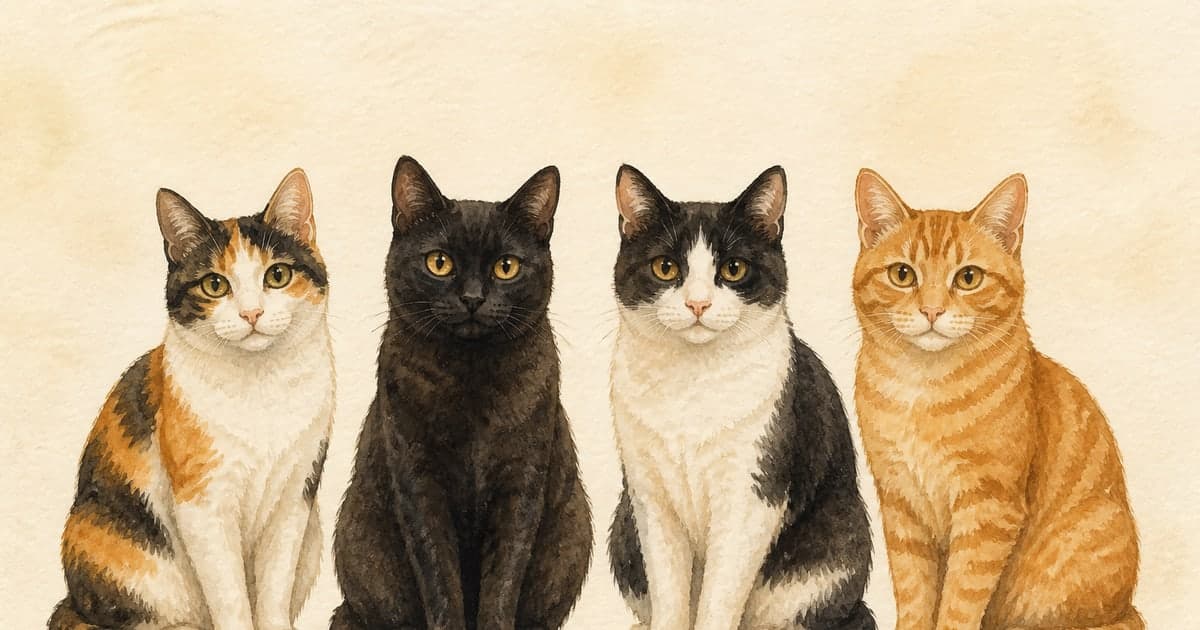
- In an owner survey, calico, tortoiseshell, black-and-white, and gray-and-white cats drew slightly more reports of aggression.
- The differences were small and rest on owners' subjective reports.
- People infer personality from coat color, and that expectation colors both reports and handling.
- Personality is shaped far more by socialization between two and seven weeks of age and by the current environment.
"Calicos are feisty." "White cats are highly strung." "Black cats are cuddly." Anyone with a cat has heard these. Have they been tested?
What a 1,274-owner survey found
Stelow and colleagues (2016) surveyed the relationship between coat color and aggressive behavior online, with 1,274 usable responses. Owners rated the frequency of aggression toward people in three settings: everyday interaction, handling, and veterinary visits.
Calicos and tortoiseshells (females carrying the sex-linked orange gene), black-and-white cats, and gray-and-white cats drew more frequent reports in all three settings. The authors are explicit that although the differences reached statistical detection, they were not large and should not guide the choice of a cat.
The expectation problem
This kind of survey has a structural weakness: the respondents are owners, and owners may already know the folklore about feisty calicos.
Delgado and colleagues (2012) asked how people infer feline personality from color. Orange cats were rated friendly, tricolor cats intolerant, white and tricolor cats aloof. Such expectations do not merely bias reporting; they can change how a cat is handled, and thus its actual behavior.
Could there be a biological link?
A route from pigment genes to behavior is theoretically possible. Genes involved in melanin synthesis partly share pathways with neurotransmitter metabolism, and domestication research has observed coat color changing alongside tameness — the fox domestication experiment being the famous case.
None of that has been demonstrated in cats. What is solid today is the existence of the stereotype and a small difference in owner reports. The framework for feline personality research is in feline personality types.
What really shapes personality
First, the socialization window from two to seven weeks. Kittens who met several people calmly in that period tend to stay less wary of humans as adults (kitten cognitive development).
Second, temperament inherited from the father; friendliness toward people has a reported genetic contribution. Third, the current environment. Where hiding places, high perches, and litter boxes are too few, cats of any color turn defensive (stress and cognition in cats).
The cost to rescue work
Color folklore does real damage. Lower adoption rates for black cats have been reported in several countries, attributed to poor photographs and lingering superstition. The habit of inferring personality from color shapes cats' fates.
What to look at when adopting is not the color but how that individual responds to people. How to think about feline intelligence and personality is summarized in can a cat's IQ be measured?.
Appearance predicts little in humans either
In humans, inferring personality or ability from appearance has repeatedly proved inaccurate. IQ is not visible either (traits of high-IQ people). NekoIQ's free IQ test runs four non-verbal domains across 20 items in about 10 minutes, returning an estimated IQ and percentile. Results are estimates for self-understanding, not an official intelligence test.
Frequently asked questions
- Are calico cats really feisty?
Owner surveys report slightly more aggression toward humans in calicos and tortoiseshells. The differences are small, and owners' expectations cannot be ruled out of the reports.
- Is coat color related to intelligence?
There is no evidence for it. No study links coat color to performance on cognitive tasks; individual differences in learning are better explained by experience and environment.
- What actually determines a cat's personality?
How calmly it met people between two and seven weeks of age, the temperament inherited from its father, and how safe its current environment is. All matter far more than color.
Share this article
Measure your IQ for free
20 questions in about 10 minutes give you your estimated IQ, deviation score, and national ranking.
Take the IQ test →Related articles
Editorial note & disclaimer
This article was written and edited by the NekoIQ Editorial Team using peer-reviewed research in animal cognition, behavior, and veterinary science. We distinguish the study's measured result from interpretation and report limitations such as sample size, task fit, and motivation where relevant.
The tests on this site provide estimates for entertainment and self-understanding purposes only. They are not medical or clinical assessments, nor official psychological (intelligence) tests.