Do Cats Avoid People Who Are Unkind to Their Owner? Third-Party Evaluation
Key takeaways
- Earlier research showed dogs avoid a person who refused their owner's request for help.
- Running the same procedure with cats, the cats did not avoid the non-helper.
- The result means no evidence was found that cats evaluate people from third-party interactions.
- Cats do use human pointing and their owner's emotional cues, so they are not indifferent to social information in general.
People evaluate others even in situations that have nothing to do with them. Watch someone ignore a person in need, and your impression of them drops. Do non-human animals do the same?
Dogs showed avoidance
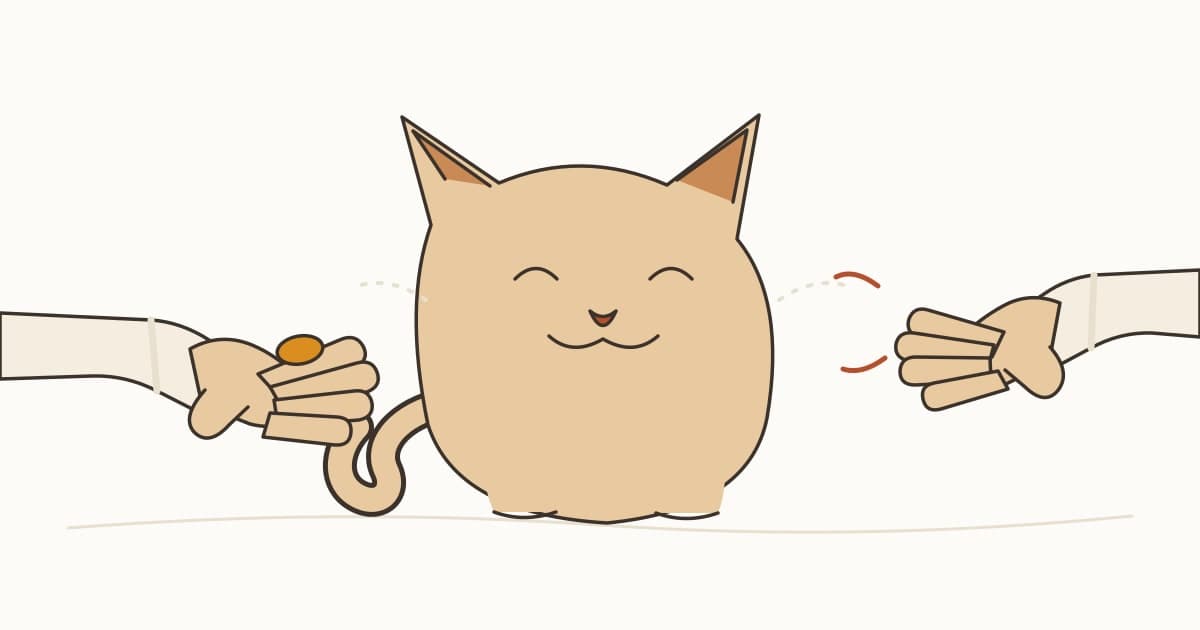
Earlier research with dogs used the following procedure. The owner tries and fails to open a transparent container, then asks the person sitting nearby for help. In the Helper condition, that second person helps open it. In the Non-Helper condition, the actor refuses and turns away. A third, passive person sits on the owner's other side.
Both people then offer food to the dog. Dogs avoided food from the person who had not helped their owner—interpreted as evaluating people from third-party interactions.
Cats did not replicate it
Chijiiwa and colleagues (2021) applied exactly the same procedure to pet cats. After watching their owner fail to open the container and ask for help, cats were offered food by the helper, the non-helper, and the neutral person.
Cats accepted food equally from either person. No tendency to avoid the non-helper appeared. The authors concluded that no evidence was found that cats evaluate humans on the basis of third-party interactions.
This is not a story about cats being aloof
Reading the result as 'cats do not care about human relationships' is premature. First, there is the question of whether the cats attended to the scene at all; sustaining attention in an experimental setting is difficult for cats.
Second, cats clearly use social information in other situations. They locate food from a human point (do cats follow human pointing?), adjust their behavior toward a novel object based on their owner's emotional reaction, and respond only to their owner's cat-directed speech (does cat-directed speech get through?).
An evolutionary reading
Third-party evaluation is valuable to animals that cooperate in groups. Knowing who is cooperative lets you choose your next partner. Dogs descend from group-hunting ancestors and were selected within cooperative work alongside humans.
The cat's ancestor, the African wildcat, hunts alone. There was little need to track reputations within a group. That difference plausibly shows up in the results (which is smarter, cats or dogs?).
What this means for owners
If cats do not evaluate third-party behavior, then the only route to a relationship with your cat is your own direct interaction with it. How someone else treated the cat matters less than how you have treated it.
Concretely, that means pairing the name with good things, not forcing handling, and always providing an escape route—direct experience, accumulated (can cats be trained?). The full picture of feline social cognition is collected in can a cat's IQ be measured?.
Social judgment in humans
Human third-party evaluation appears from infancy and is regarded as a foundation of sociality. IQ tests, by contrast, measure the discovery of abstract rules rather than social judgment (EQ versus IQ). The free NekoIQ IQ test measures four non-verbal domains in 20 questions and about 10 minutes. Results are estimates for self-understanding and are not a substitute for an official intelligence test.
Frequently asked questions
- Do cats dislike people who are unkind to their owner?
No avoidance was observed in the experiment. Cats accepted food equally from the person who refused to help their owner and from the one who helped.
- How does this differ from dogs?
With the same procedure, dogs avoided food from the person who did not help their owner. Cats showed no such tendency, and no evidence of third-party evaluation was found.
- Does that mean cats do not tell people apart?
They do. Cats discriminate their owner's voice from a stranger's and respond only to their owner's cat-directed speech. What they do not appear to evaluate is interactions between third parties.
Share this article
Measure your IQ for free
20 questions in about 10 minutes give you your estimated IQ, deviation score, and national ranking.
Take the IQ test →Related articles
Editorial note & disclaimer
This article was written and edited by the NekoIQ Editorial Team using peer-reviewed research in animal cognition, behavior, and veterinary science. We distinguish the study's measured result from interpretation and report limitations such as sample size, task fit, and motivation where relevant.
The tests on this site provide estimates for entertainment and self-understanding purposes only. They are not medical or clinical assessments, nor official psychological (intelligence) tests.