Does Cat-Directed Speech Get Through? Research on Talking to Your Cat
Key takeaways
- Cats discriminate speech addressed to them from speech addressed to adults.
- The discrimination held only for the owner's voice; with a stranger's voice, no discrimination appeared.
- Cat-directed speech shares features with infant-directed speech: a higher fundamental frequency and exaggerated intonation.
- The result suggests that the cat-owner relationship is built through individually learned associations.
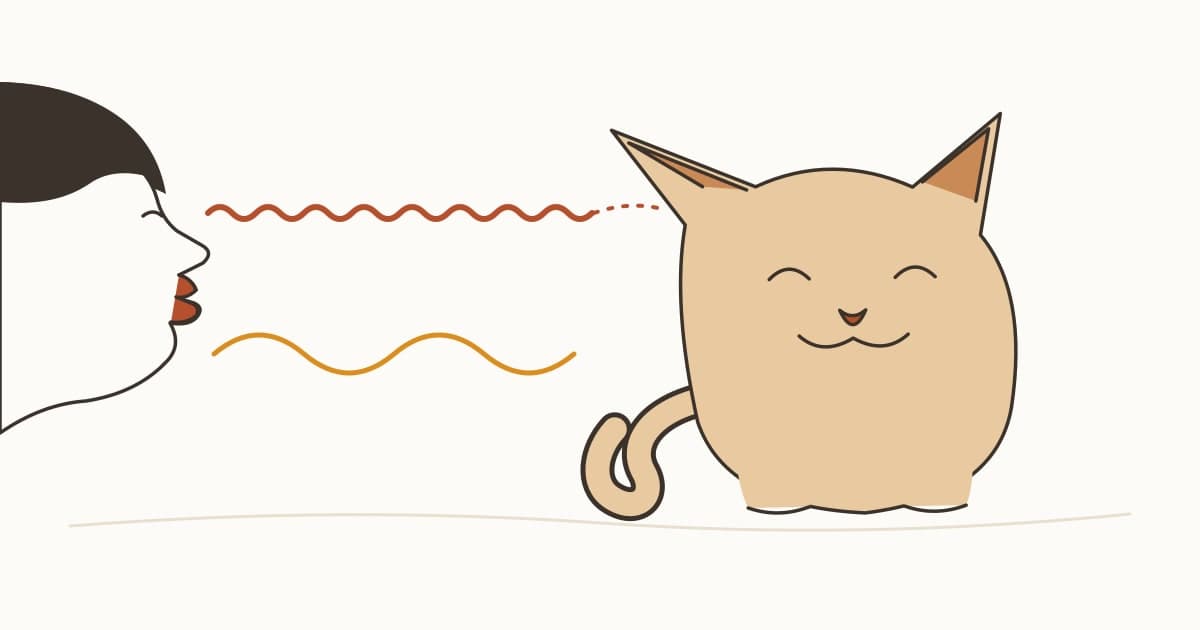
Talking to a cat, most people's voices rise and their intonation exaggerates without thinking about it. This register is called cat-directed speech, and it shares features with the way we talk to infants. Do cats notice?
An experiment with 16 cats
de Mouzon and colleagues (2022) ran playback experiments with 16 companion cats using a habituation-dishabituation paradigm. Repeatedly playing the same kind of speech weakens a cat's response (habituation); introducing a different kind then tests whether the response returns (dishabituation).
The advantage of this method is that it measures whether a difference was detected without requiring training. Tasks that need training let a cat's willingness to participate distort the result.
Discrimination only for the owner
The finding was clear. When sentences were uttered by their owner, cats discriminated cat-directed speech from adult-directed speech. When strangers uttered the same sentences, no discrimination appeared.
So cats are not responding to 'high, gentle voices' as a category. They have learned a particular person's particular register. The authors present this as evidence for the individual character of the cat-human relationship.
Shared features with infant-directed speech
When people speak to infants, the fundamental frequency rises, intonation is exaggerated, and utterances shorten. This is thought to help capture attention and convey affect. Dog-directed speech shows similar features.
Cat-directed speech shares that direction. The difference is that cats respond only to their owner. Dogs have been reported to respond to dog-directed speech from strangers as well, and the contrast may reflect differences in sociality (which is smarter, cats or dogs?).
Connecting names, voices, and scent
That cats respond specially to their owner fits other research. Cats discriminate their owner's voice from a stranger's (Saito and Shinozuka, 2013) and discriminate their own name from other words (Saito and colleagues, 2019).
Taken together, what a cat learns is less 'language' than 'this sound pattern from this individual' (do cats understand human language?).
How to actually talk to your cat
First, keep the name short. A consistent sound shape repeated is learned more readily than a long call. Second, call just before something good happens; a name paired with punishment stops working. Third, avoid staring head-on, and add a slow blink.
Fourth, avoid loud volume. Feline hearing extends well above the human range, and loud sound is a serious stressor (stress and cognition in cats).
Human language and intelligence
Human intelligence tests include verbal items, but those are sensitive to first language and education (what is a culture-fair test?). The free NekoIQ IQ test is built from language-free figural items, measuring four domains in 20 questions and about 10 minutes. Results are estimates for self-understanding and are not a substitute for an official intelligence test.
Frequently asked questions
- Is there any point in talking to my cat?
Yes. Experiments show cats discriminate their owner's cat-directed speech from adult-directed speech and respond more strongly to the former.
- Does it work if a stranger uses the same voice?
In the same experiment, cats did not discriminate cat-directed from adult-directed speech when the speaker was a stranger. Who is speaking appears to matter.
- Do cats understand the meaning of words?
Evidence for word meaning is limited. Cats do discriminate their own name from other words, so sound patterns heard repeatedly are clearly learned.
Share this article

Measure your IQ for free
20 questions in about 10 minutes give you your estimated IQ, deviation score, and national ranking.
Take the IQ test →Related articles
Editorial note & disclaimer
This article was written and edited by the NekoIQ Editorial Team using peer-reviewed research in animal cognition, behavior, and veterinary science. We distinguish the study's measured result from interpretation and report limitations such as sample size, task fit, and motivation where relevant.
The tests on this site provide estimates for entertainment and self-understanding purposes only. They are not medical or clinical assessments, nor official psychological (intelligence) tests.