Does the Owner's Personality Affect the Cat? A Survey of 3,331 Owners
Key takeaways
- Higher owner neuroticism went with more reported behavior problems and stress-related illness in their cats.
- The same owners reported less outdoor access and more cats outside an ideal weight.
- The authors compare the pattern to the link between parental personality and child adjustment.
- The survey shows correlation; it does not establish that owner personality is the cause.
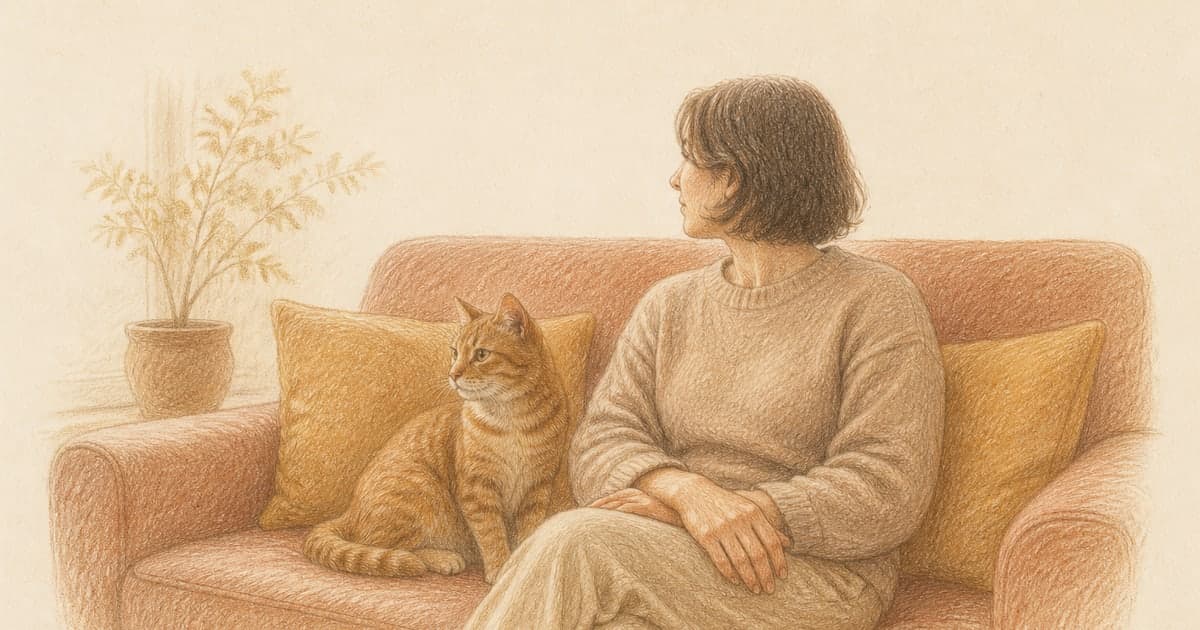
What drives a cat's behavior is not only on the cat's side. The personality of the person sharing the house designs the cat's living conditions.
A study of 3,331 owners
Finka and colleagues (2019) gave 3,331 cat owners the Big Five personality inventory — agreeableness, conscientiousness, extraversion, neuroticism, openness — alongside questions about their cats' health, behavior, and management.
The most consistent associations involved neuroticism. Owners scoring higher reported more aggression, anxiety, and fearfulness in their cats, along with more stress-related illness and more cats outside an ideal weight. Their cats also had less outdoor access.
The parallel with parenting
The authors note that this structure parallels findings in developmental psychology: households where parental neuroticism is high tend toward controlling parenting styles, and child anxiety tends to be higher.
For cats, control would show up as restricting behavior or over-monitoring. But it is equally possible that problem behavior in the cat raises the owner's anxiety. Correlational work cannot fix the direction.
What "cats resemble their owners" really means
The saying does not imply that cats imitate personalities. An owner's traits govern every environmental variable — where resources sit, how often visitors come, the daily rhythm, how scolding is used, when a vet is consulted. The cat adapts to that environment.
What we see is not resemblance but transmission through the environment. The framework for assessing feline personality is in feline personality types.
Concrete steps on the environment side
First, distribute resources: litter boxes numbering cats plus one, water separated from food, several high perches and hiding places. Non-competing resources reduce defensive behavior (why do cats love boxes?).
Second, keep the rhythm steady. Predictable meal and play times lower stress. Third, drop scolding. Punishment does not stop behavior; it turns you into an unpredictable threat (can cats be trained?).
Fourth, manage your own stress. Human tension reaches the cat through posture, voice, and touch, and cats consult their owner's emotional reaction when deciding how to treat something unfamiliar (do cats read human emotions?).
Limits of the study
Everything here is owner self-report. People high in neuroticism tend to report problems more strongly, so reporting bias may inflate the association. Cross-checking against behavioral observation and veterinary records is the next step.
When reading feline research, go back to who measured what. The full map of feline cognition and behavior research is in can a cat's IQ be measured?.
Human stress and cognition
In humans, chronic anxiety effectively consumes working memory capacity and lowers task performance (IQ and mental resilience). Arranging life with a cat well also lowers the load on your side. NekoIQ's free IQ test covers four non-verbal domains across 20 items in about 10 minutes, returning an estimated IQ and percentile. Results are estimates for self-understanding, not an official intelligence test.
Frequently asked questions
- Does an owner's personality affect their cat?
An association is reported. Across 3,331 owners, higher neuroticism went with more reported problem behavior, anxiety, and stress-related illness in cats. Causation is not established.
- Do cats resemble their owners?
Resemblance is reported, but cats do not imitate personality. The owner's traits shape the environment and handling, and the cat's behavior reflects that.
- Should anxious people avoid keeping cats?
No. The findings are correlational, and the effect can be reduced by how the environment is arranged. Hiding places and a steady daily rhythm help.
Share this article
Measure your IQ for free
20 questions in about 10 minutes give you your estimated IQ, deviation score, and national ranking.
Take the IQ test →Related articles
Editorial note & disclaimer
This article was written and edited by the NekoIQ Editorial Team using peer-reviewed research in animal cognition, behavior, and veterinary science. We distinguish the study's measured result from interpretation and report limitations such as sample size, task fit, and motivation where relevant.
The tests on this site provide estimates for entertainment and self-understanding purposes only. They are not medical or clinical assessments, nor official psychological (intelligence) tests.