Do Cats Have 276 Facial Expressions? What Facial-Signal Research Shows
Key takeaways
- Observing 53 adult cats at a cat café, researchers recorded 276 facial expressions during intraspecific interaction.
- Expressions are built from combinations of multiple facial movements involving ears, eyes, whiskers, and mouth.
- The physical form of facial signals differed between affiliative and non-affiliative contexts.
- The richness of feline facial signaling is discussed in relation to sociality acquired through domestication.
Cats are often said to be inexpressive. Code their facial movements in detail, though, and a very different picture emerges.
276 expressions at a cat café
Scott and Florkiewicz (2023) observed 53 adult domestic shorthair cats at CatCafé Lounge in Los Angeles, using a Facial Action Coding System designed for cats to record the facial movements produced during cat-to-cat interaction.
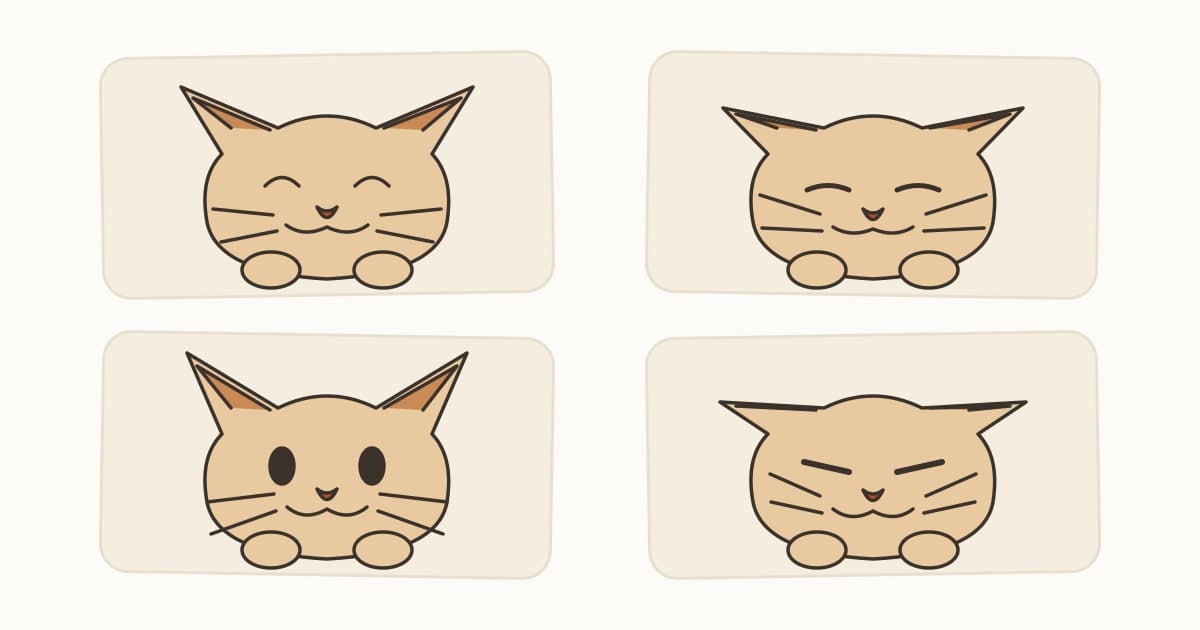
Across affiliative and non-affiliative contexts, 276 morphologically distinct expressions were documented. That does not mean cats have 276 emotions. Expressions combine movements of the ears, eyes, whiskers, and mouth, so the number of combinations grows large.
Affiliative and non-affiliative faces differ in form
The point of the study was not counting but relating the physical form of signals to their social function. The researchers predicted that affiliative and non-affiliative expressions would differ noticeably in complexity and composition, and they found differences.
This suggests feline facial signals are not merely emotional leakage but may serve a social function directed at another individual.
Why cats have so many
The authors discuss this alongside domestication: as cats came to live around humans, they also came to live near each other. Wildcats are largely solitary. Cats gathered around human settlements had to coexist with conspecifics at close range.
Close coexistence requires signals to defuse conflict and maintain relationships. Rich facial signaling may be part of that adaptation.
Expressions aimed at humans are another matter
This study examined cat-to-cat interaction. Human-directed communication has separate research. de Mouzon and colleagues (2023) compared cats' responses when owners used voice only, visual cues only, or both, and reported that behavior varied with the modality of communication.
Slow blinking has also been shown to increase cats' narrowed-eye responses and to make cats more likely to approach an unfamiliar person (do cats understand human language?).
How owners can actually read a face
First, never judge from one part alone; ears only or tail only invites misreading. Second, read with context—the same ear angle means different things during play and on an examination table. Third, watch for change: a deviation from that cat's usual face is the most informative signal.
For pain, veterinary medicine has developed a dedicated scale (the Feline Grimace Scale). If facial changes persist, consider a veterinary visit (can cats develop dementia?).
Reading faces and human intelligence
In humans too, reading expressions is treated as social cognition rather than a target of intelligence testing (EQ versus IQ). The free NekoIQ IQ test measures non-verbal reasoning about figural rules across four domains in 20 questions and about 10 minutes. Results are estimates for self-understanding and are not a substitute for an official intelligence test.
Frequently asked questions
- How many facial expressions do cats have?
Observing 53 adult cats at a cat café, researchers recorded 276 morphologically distinct facial expressions during cat-to-cat interaction, because expressions combine multiple facial movements.
- Can I read my cat's mood from its face?
It is a useful cue in context. Facial signals differ in form between affiliative and non-affiliative situations, but no single expression establishes an emotion on its own.
- What do flattened ears mean?
They are generally associated with wariness, discomfort, or a defensive state, but reading ears alone is risky. Combine posture, tail, whiskers, and the situation.
Share this article

Measure your IQ for free
20 questions in about 10 minutes give you your estimated IQ, deviation score, and national ranking.
Take the IQ test →Related articles
Editorial note & disclaimer
This article was written and edited by the NekoIQ Editorial Team using peer-reviewed research in animal cognition, behavior, and veterinary science. We distinguish the study's measured result from interpretation and report limitations such as sample size, task fit, and motivation where relevant.
The tests on this site provide estimates for entertainment and self-understanding purposes only. They are not medical or clinical assessments, nor official psychological (intelligence) tests.