How Good Are Cats at Problem Solving? What String-Pulling Tasks Show
Key takeaways
- All 15 cats pulled a single string successfully, yet none consistently chose the correct string when two were presented.
- With crossed strings, one cat consistently chose the wrong string and the rest performed at chance.
- In Thorndike's puzzle box, escape times shortened gradually, indicating trial-and-error learning rather than insight.
- Cats readily learn links between action and outcome, but evidence that they reason about mechanisms is weak.
A cat pressing a lever to open a door, or pulling a drawer to reach treats. On video it looks clever. But does a cat understand the 'if this, then that' behind it? The experimental answer is more cautious than you might expect.
String-pulling: a standard probe of causal understanding
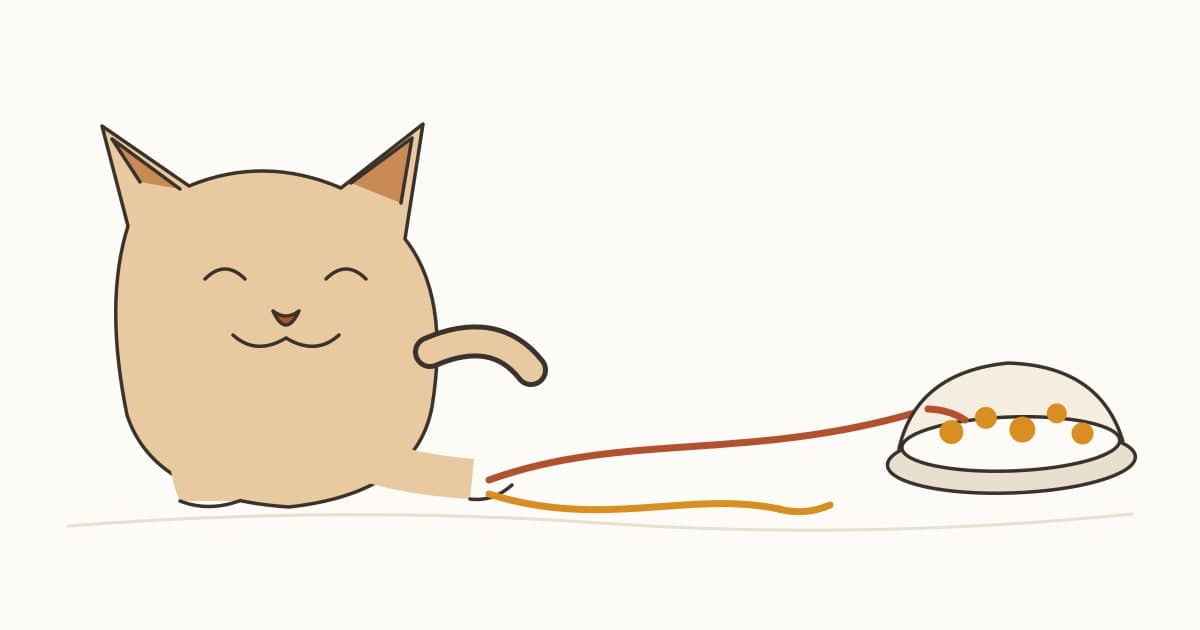
A standard way to test causal understanding in animals is the string-pulling task. A string is attached to a dish of food; pulling it brings the food within reach. Several strings are offered, and the question is whether the animal picks the one actually connected to the food.
Whitt and colleagues (2009) ran this task with 15 pet cats. With a single string, every cat pulled and obtained the treat. But when two parallel strings were offered with only one baited, not one cat consistently chose correctly.
What the crossed condition revealed
Harder still is the crossed condition, where the visible position of a string and its actual connection diverge, so the line has to be traced. Here one cat consistently chose the wrong string and the remaining cats performed at chance.
The researchers concluded that there was no evidence cats understand the function of the strings or their physical causality. Every cat can perform the action of pulling, yet none can judge which string leads to the food. That gap is exactly the boundary between learning an action and understanding a cause.
Thorndike's puzzle box and what the learning curve says
This conclusion is not new. In 1898, Thorndike placed cats in 'puzzle boxes' and timed their escapes as they operated an internal lever or loop. If a cat solved the box by understanding its mechanism, the time should collapse the moment insight struck.
The records showed something else. Escape times shortened gradually. Cats tried many behaviors inside the box, and whichever happened to work was repeated more often. Thorndike called this the law of effect, and it became a foundation of learning psychology.
How to read those 'clever cat' videos
A cat turning a doorknob or opening a refrigerator is fully explained by the law of effect. Repeated attempts leave behind the successful movement, which then gets refined. No understanding of the mechanism is required.
This is not a low opinion of cats. Trial-and-error learning is powerful and keeps working when the environment changes. The way cats learn cues and tricks follows the same principle (can cats be trained?).
Where cats do show something more
On the other hand, cats have been reported to look longer in conditions that violate expectations built from sound, suggesting they infer an unseen object's presence from noise (Takagi and colleagues, 2016). Use of physical cues does appear, depending on the shape of the task.
Feline ability has to be assessed task by task; one result cannot be extrapolated into a general intelligence claim (can a cat's IQ be measured?).
Insight and logic in humans
Human problem solving also mixes trial and error with grasping a structure and solving in one move. IQ figural items aim at the latter (how to train logical thinking). The free NekoIQ IQ test asks you to find a rule and predict what comes next across 20 questions in about 10 minutes. Results are estimates for self-understanding and are not a substitute for an official intelligence test.
Frequently asked questions
- Do cats understand that pulling a string brings food?
No evidence supports it. In string-pulling research, cats pulled a single string easily but did not exceed chance when choosing the correct string among several.
- How do cats learn new things?
Mainly by trial and error. When a behavior is followed by a good outcome, that behavior becomes more likely—the pattern Thorndike formalized as the law of effect.
- How can a cat open a door, then?
An action that happened to work is reinforced by its outcome and becomes more efficient with repetition. The cat is not thought to understand the door's mechanism.
Share this article

Measure your IQ for free
20 questions in about 10 minutes give you your estimated IQ, deviation score, and national ranking.
Take the IQ test →Related articles
Editorial note & disclaimer
This article was written and edited by the NekoIQ Editorial Team using peer-reviewed research in animal cognition, behavior, and veterinary science. We distinguish the study's measured result from interpretation and report limitations such as sample size, task fit, and motivation where relevant.
The tests on this site provide estimates for entertainment and self-understanding purposes only. They are not medical or clinical assessments, nor official psychological (intelligence) tests.