Do Cats Remember Hidden Objects? Research on Object Permanence
Key takeaways
- Adult cats solve visible-displacement tasks in which an object is hidden in front of them.
- Performance drops sharply on invisible displacements, where the object is moved while enclosed in a container.
- Object permanence is a framework for describing human infant development, and cats' performance has been mapped onto its stages.
- Matching a stage does not mean matching cognition overall, and it is not grounds for converting a cat to a human age.
Roll a toy under the sofa and a cat pushes a front paw in to search. That ordinary behavior is an expression of what cognitive science calls object permanence: the understanding that things continue to exist once out of sight.
Visible displacement is solved
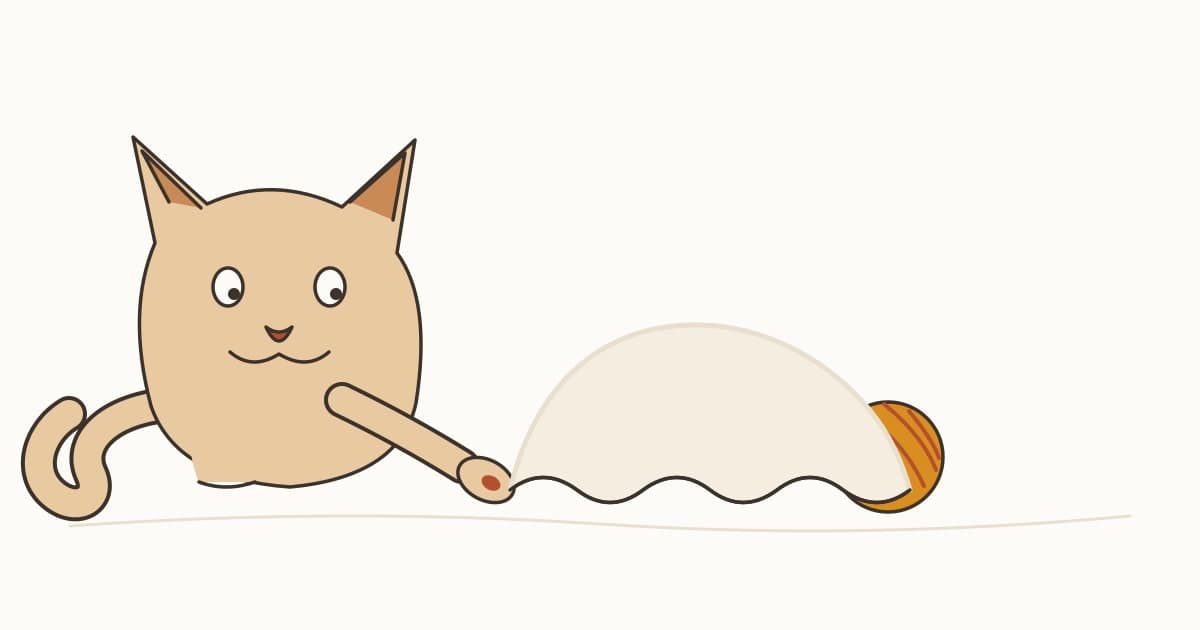
Doré (1986) ran object-permanence tasks systematically with adult cats. In the visible-displacement condition, where the object is hidden under a cover in full view, cats correctly searched the hiding place.
That level corresponds to what stabilizes in human infants around the first year. For a cat, it is also directly tied to hunting: ambush predation cannot work unless prey that vanishes into the grass is still understood to exist.
Invisible displacement is where performance falls
The hard case is invisible displacement. The object is placed inside a hand or container, moved among several covers, and finally left under one of them. The object's path is never visible, so it has to be tracked mentally.
In Doré's work, cats' performance dropped substantially in this condition. In humans the corresponding level stabilizes around age two, and this is where cats are generally said to hit a wall. Later work shows results shift with task design, so it is more accurate to say performance varies strongly with conditions than to say cats simply cannot do it.
Limits on how long the location is held
There are also limits on retention. Fiset and Doré (2006) varied the delay in a task where an object was hidden in one of four boxes and reported that accuracy fell rapidly between 0 and 30 seconds while still exceeding chance at 60 seconds.
So even though a cat understands that a hidden object still exists, the memory of where it is becomes unreliable within tens of seconds. Giving up the search can be explained by memory decay rather than a failure of understanding (how good is a cat's memory?).
Tips for trying it at home
Hiding a toy under a cloth is easy to try. First, hide it while the cat is watching. Second, allow the search within about ten seconds. Third, reward a find with play.
If it does not work, take feline vision into account. Cats respond far more strongly to moving objects than static ones, so a small movement just before hiding draws attention. Detailed procedures are collected in five feline intelligence tests to try at home.
The limits of 'like a toddler'
Mapping object-permanence stages onto human development is a useful research convenience. Concluding from that match that a cat 'is X years old' is a leap. Cats far exceed toddlers at sound localization and motion vision, and produce no scores at all on language tasks. A differently shaped profile cannot be loaded onto one age axis (what is a cat's average IQ?).
Measuring human spatial cognition
Tracking an invisible displacement mentally relates, in humans, to spatial cognition and working memory (how to train spatial reasoning). The free NekoIQ IQ test includes spatial-reasoning items involving rotation and unfolding across four domains in 20 questions and about 10 minutes. Results are estimates for self-understanding and are not a substitute for an official intelligence test.
Frequently asked questions
- Will a cat search for a hidden toy?
Yes, if it was hidden in view. Cats understand that an object continues to exist after disappearing and search using the hiding place they just saw.
- Why do cats give up searching?
The information about the hiding place is retained only briefly. In hidden-object tasks, accuracy declines sharply between 0 and 30 seconds. Waning interest is another reason.
- What is object permanence?
The understanding that objects continue to exist when out of sight. In humans it is acquired in stages during infancy, and it is used as a comparative benchmark in animal cognition research.
Share this article

Measure your IQ for free
20 questions in about 10 minutes give you your estimated IQ, deviation score, and national ranking.
Take the IQ test →Related articles
Editorial note & disclaimer
This article was written and edited by the NekoIQ Editorial Team using peer-reviewed research in animal cognition, behavior, and veterinary science. We distinguish the study's measured result from interpretation and report limitations such as sample size, task fit, and motivation where relevant.
The tests on this site provide estimates for entertainment and self-understanding purposes only. They are not medical or clinical assessments, nor official psychological (intelligence) tests.